
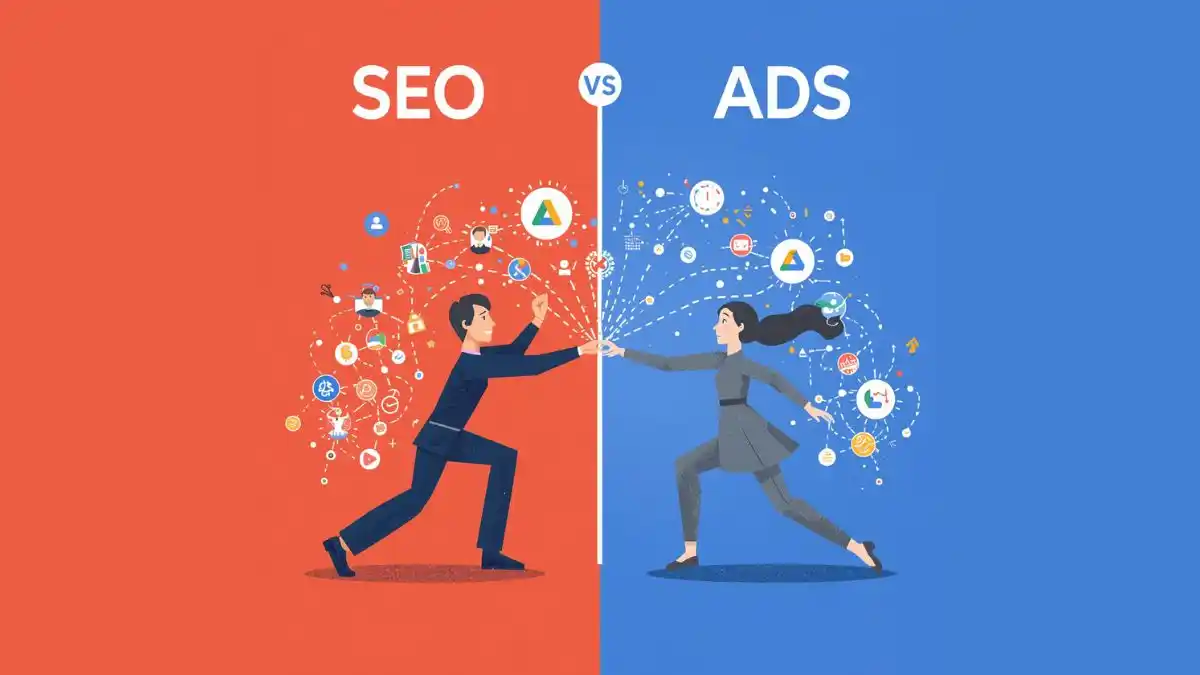

SEO and Google Ads solve different problems for a local business. Google Ads can generate visibility and leads quickly when the campaign is tightly targeted and funded. SEO takes longer, but it can build durable organic visibility across Search, Maps and related discovery surfaces without paying for every click.
For many local businesses, the strongest strategy is not choosing one forever. It is knowing which channel should do which job.
SEO vs Google Ads at a glance
| Area | SEO | Google Ads |
|---|---|---|
| Speed | Usually slower | Can generate visibility quickly |
| Cost model | Investment in optimisation, content and technical work | Pay for clicks/interactions plus management |
| Durability | Can continue producing visibility after work is published | Traffic normally stops when spend stops |
| Control | Limited control over rankings | Greater control over keywords, locations, schedules and budget |
| Best use | Long-term visibility and authority | Immediate demand capture and testing |
What SEO does
SEO improves a website and its wider search presence so relevant customers can find it organically.
For a local business, that can include service pages, technical SEO, internal linking, Google Business Profile, reviews, local relevance and useful supporting content.
SEO does not mean “free traffic” because good work still costs time or money. The difference is that you do not pay Google every time somebody clicks an organic result.
What Google Ads does
Google Ads lets a business pay for visibility on relevant searches.
A well-built campaign can target particular keywords, locations, devices, times and audiences. That makes Ads useful when a business needs leads now, wants to test demand or needs to appear for highly commercial searches before organic rankings are established.
The downside is that wasted clicks can become expensive very quickly if targeting, keywords, negatives and conversion tracking are weak.
Which works faster?
Google Ads usually works faster.
Once a campaign is approved and eligible to serve, it can begin generating impressions and clicks without waiting for organic rankings to develop.
SEO is slower because search engines need to crawl, process and reassess pages, while authority and competition also affect how quickly results move.
Which is cheaper?
There is no universal answer.
Ads can be efficient when a business knows its profitable keywords, conversion rate and customer value. They can also waste money when one irrelevant click consumes a large part of a small daily budget.
SEO can become cost-effective over time when strong pages continue attracting qualified traffic, but competitive SEO also requires ongoing investment.
The right comparison is cost per qualified enquiry or sale, not simply cost per click.
Which is better for an urgent service?
Google Ads can be especially useful for urgent-intent services such as emergency plumbing, locksmith work or website repair because the customer often wants help immediately.
In those markets, campaigns should be very tightly controlled. High-intent keywords, strong negative-keyword lists, small geographic targeting and call conversion tracking can matter more than broad reach.
SEO still matters because organic and local visibility can reduce dependence on paid traffic over time.
Which is better for local visibility?
SEO is usually the stronger long-term foundation for local visibility because it combines the website, Google Business Profile, local content and reputation signals.
Google says local organic results are mainly influenced by relevance, distance and prominence.
Our local SEO guide explains how those pieces work together.
Can SEO and Ads support each other?
Yes.
Ads can reveal which commercial searches actually generate enquiries. That information can help prioritise service pages and organic content.
SEO can also improve landing pages, speed, clarity and trust, which can support paid conversion performance.
Using both channels does not mean duplicating spend. It means assigning each channel a clear role.
When Google Ads is usually the better first move
- You need leads immediately.
- You are launching a new service with little organic visibility.
- You want to test whether a keyword converts before investing heavily in content.
- You have a clear conversion action and reliable tracking.
- You can afford enough budget to gather useful data.
When SEO is usually the better first move
- You want to build long-term local visibility.
- Your paid-click costs are difficult to sustain.
- You have strong services but weak organic pages.
- Your website has technical or structural problems.
- You want visibility across Search, Maps and AI-assisted discovery over time.
What small budgets should avoid
A small budget needs tighter targeting, not broader targeting.
Avoid launching with large lists of vague keywords, broad geographic coverage and weak negatives. One or two irrelevant clicks can consume a significant share of a limited daily budget.
Start with the most commercial searches, measure actual conversions and expand only when the data supports it.
What should you measure?
For both SEO and Ads, the useful metrics depend on the business outcome.
- Qualified calls
- Enquiry forms
- Bookings
- Sales
- Cost per acquisition
- Conversion rate
- Revenue where available
Clicks and impressions are diagnostic metrics. They do not tell you on their own whether the marketing is profitable.
How AI search changes the comparison
AI search does not make SEO obsolete.
Google’s current guidance says established SEO fundamentals remain relevant for AI Overviews and AI Mode. Useful content, crawlability, internal links, page experience and accurate business information still matter.
Paid advertising remains a separate way to buy visibility. Businesses should not assume that organic AI visibility can be purchased through SEO or guaranteed by an agency.
A practical strategy for a local business
- Make sure the website converts properly before buying more traffic.
- Build or improve the highest-intent service pages.
- Set up accurate conversion tracking.
- Use tightly controlled Ads for urgent or high-value searches.
- Build local SEO and Google Business Profile visibility in parallel.
- Review which queries actually generate business.
- Shift budget towards the channels and searches producing profitable outcomes.
Bottom line
Use Google Ads when speed and control matter most. Use SEO when you want to build long-term organic visibility and reduce dependence on paid clicks.
For many local businesses, the best commercial answer is a disciplined mix of both rather than treating them as rivals.
If your organic foundation needs work, see our SEO services.