
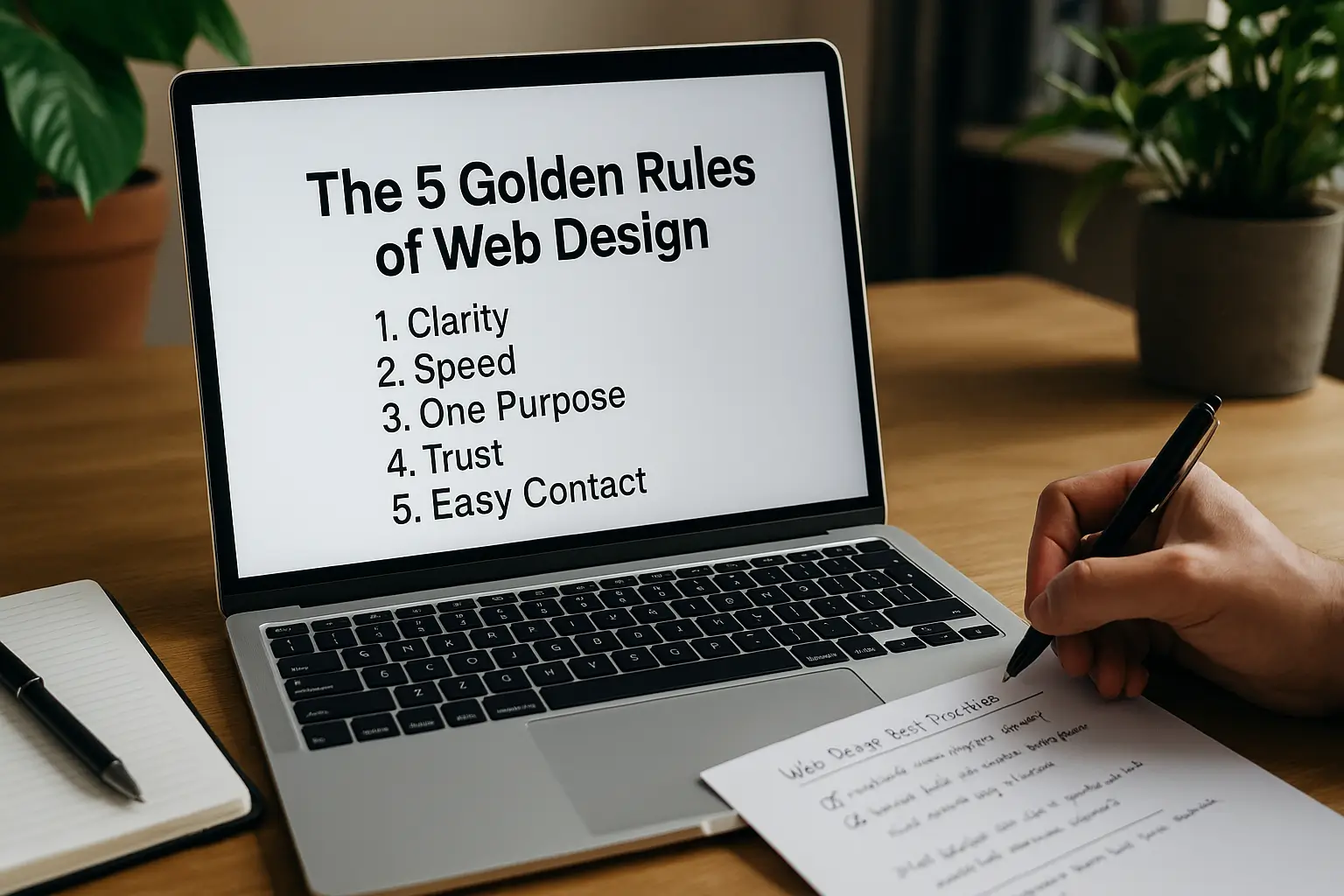

A small-business website in Croydon does not need clever tricks. It needs to explain the service clearly, work properly on mobile, build trust and make the next step obvious. These five rules are practical design principles, not guarantees of rankings or enquiries.
Rule 1: Explain the business quickly
The first screen should make it easy to understand what the business does, who it serves and what action the visitor should take next.
A clear headline is usually more useful than a vague slogan. For example, “Web design for Croydon small businesses” communicates more than “Digital solutions for ambitious brands”.
Useful first-screen elements include:
- a clear service-led headline;
- a short supporting sentence;
- one main call to action;
- location information where it genuinely matters.
Rule 2: Make mobile use effortless
Local customers often visit from phones, so test the real mobile experience rather than assuming a responsive template is enough.
Check that text is readable, buttons are easy to tap, menus work, forms are usable and phone numbers can be called with one tap.
Rule 3: Keep performance under control
Slow pages create friction, but a perfect Lighthouse score is not the objective. Prioritise oversized images, slow server response, unnecessary scripts and unstable layouts.
Google recommends good Core Web Vitals as part of a strong page experience, but speed is only one part of search performance. Relevance, content quality and technical accessibility also matter.
See our guide to why website speed matters for the practical details.
Rule 4: Prove the business is trustworthy
Trust comes from evidence, not adjectives. Useful proof can include:
- real customer reviews;
- real photographs;
- named people or team information;
- verifiable credentials;
- case studies based on genuine work;
- clear company and contact information.
Avoid invented results, arbitrary percentage improvements or fabricated case studies. If you do not have evidence for a claim, do not publish it as fact.
Rule 5: Make the next step obvious
Every important page should have a clear purpose. A visitor might need to call, request a quote, book, send details or view pricing. The call to action should match that intent.
Do not fill every section with a different button. Use a consistent next step at the points where a customer is likely to be ready.
How these rules work together
Good design is not separate from SEO or conversion. Clear structure helps users understand the page. Fast, stable layouts reduce friction. Trust evidence helps people decide. Useful service content supports search intent.
For a wider checklist, see our Croydon SEO-ready website checklist.
Quick Croydon website check
- Open the homepage on your phone.
- Can you identify the service immediately?
- Can you find the main contact option without searching?
- Does the page show real proof?
- Does the site feel fast and stable?
- Do the main service pages answer buying questions?
Final takeaway
The best Croydon small-business websites are usually clear, useful and easy to trust. Design should support the customer journey rather than distract from it.