
Local SEO advice becomes useless when every task is presented as equally important.
For a service business, the work should happen in an order. First make the business easy for Google to understand. Then make the services easy to match to searches. Then add proof, reviews and local authority. Only after those foundations are working should you spend time on the long tail of citations, content and smaller technical refinements.
That matters because a plumber with the wrong Google Business Profile category does not need another blog post. A locksmith with no dedicated service pages does not need 200 directory listings. A salon with 300 reviews and a broken booking form does not need more visibility until the customer journey works.
Work the checklist in the order that removes the biggest constraint first.
For most service businesses that means: Google Business Profile → reviews and trust → dedicated service pages → genuine location relevance → technical health → citations and links → measurement and continuous improvement.
What are you actually trying to rank for?
Local SEO has two related but different search surfaces.
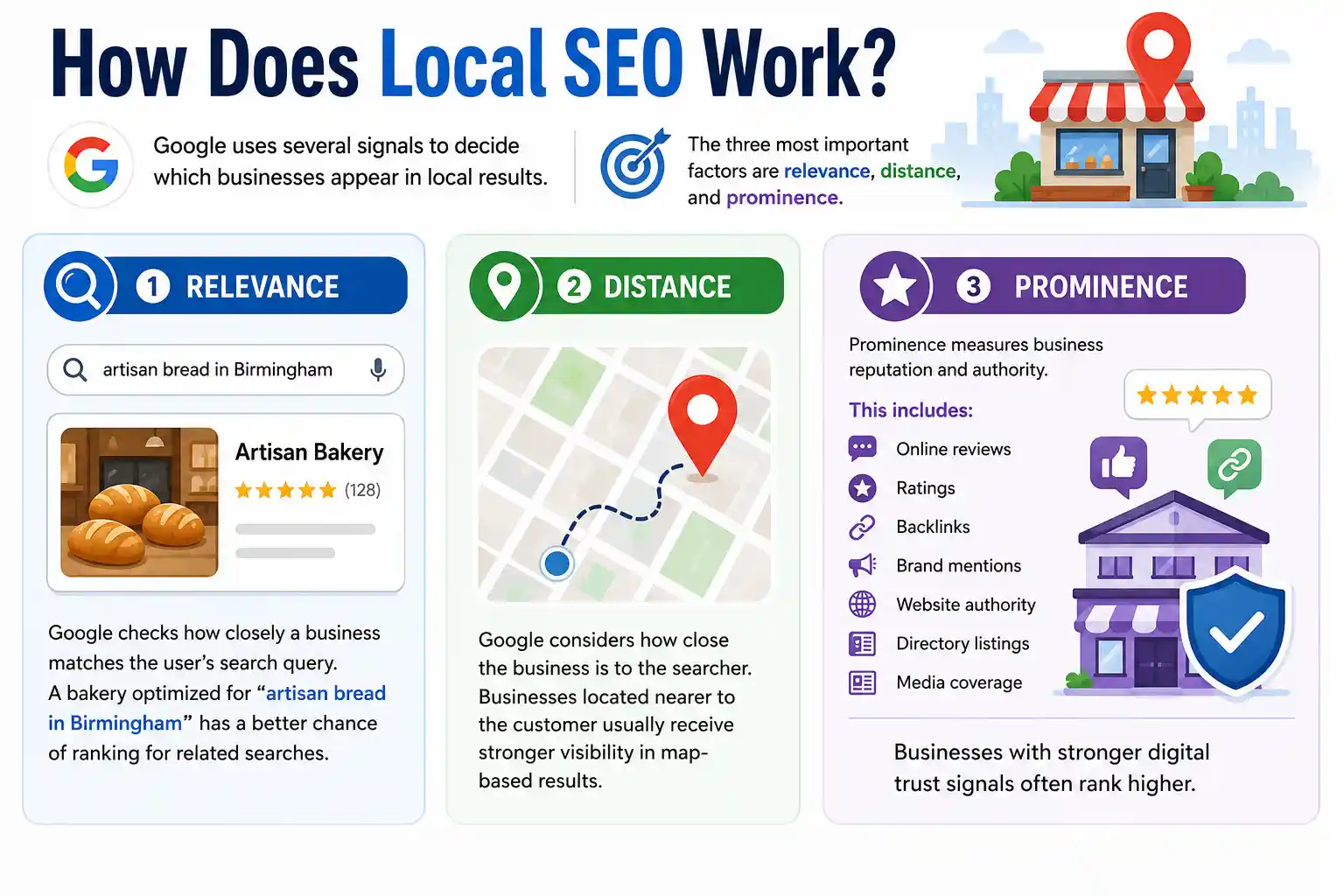
The map pack is influenced heavily by the Google Business Profile, proximity, relevance and prominence. The organic results depend much more heavily on the website: page relevance, content quality, internal links, authority and technical health.
A service business needs both.
Your profile may win visibility for “electrician near me”, while your website wins “consumer unit replacement Croydon”, “emergency electrician Bromley” or a detailed service question.
That is why local SEO is not just a Google Business Profile checklist.
Phase 1: get the business entity right
1. Confirm the business is eligible for a Google Business Profile
Before optimising anything, make sure the business model matches Google’s rules.
If customers visit your premises during stated hours, an address may be appropriate. If you travel to customers and do not receive visitors at your home or office, use the correct service-area setup and hide the address where required.
Trying to manufacture extra locations or virtual offices creates risk that no amount of optimisation can compensate for.
2. Use the real-world business name
Do not add keywords to the profile name unless they are genuinely part of the business name used in the real world.
“Smith & Co Plumbing” is not improved by becoming “Smith & Co Plumbing Emergency Plumber London 24/7” if that is not the actual trading name.
3. Choose the most accurate primary category
This is one of the highest-leverage decisions in local SEO.
Choose the category that best describes the main thing customers hire you for, not the broadest category that sounds impressive.
Then add relevant secondary categories for genuine additional services.
4. Complete the profile properly
Check:
- phone number;
- website;
- opening hours;
- holiday hours;
- service areas;
- services;
- attributes;
- appointment or booking links;
- business description;
- photos.
The goal is not to fill fields for the sake of a completion score. It is to make the profile accurate and useful.
5. Use real photos
Real work beats stock photography for trust.
Add:
- team members;
- vehicles;
- completed jobs;
- premises where appropriate;
- equipment;
- before-and-after work where useful.
For a service business, these images also provide evidence that the company genuinely operates in the market it claims to serve.
Phase 2: make the website and profile agree
6. Match the main service intent
If the profile says the business is primarily an air-conditioning installer but the website homepage is mostly about generic facilities management, the signals are weak.
The website should make it obvious:
- what the business does;
- where it operates;
- which services are most important;
- how to contact or book.
7. Keep core business details consistent
Name, address where public, phone and website should be consistent across the profile, website and important external listings.
Do not obsess over punctuation differences. Focus on genuine inconsistencies such as:
- old phone numbers;
- previous addresses;
- duplicate profiles;
- incorrect trading names;
- wrong website URLs;
- old opening hours.
Phase 3: build one strong page for each important service
8. Give major services their own useful pages
A generic services page listing twelve things in bullet points rarely gives search engines or customers enough depth.
If people genuinely search for a service independently, it may deserve its own page.
A good service page should explain:
- what the service is;
- who needs it;
- common problems or triggers;
- what the process looks like;
- what affects cost;
- how long it takes;
- relevant proof;
- the areas served;
- what happens next.
9. Do not create a page for every keyword variation
“Boiler repair”, “boiler repairs”, “repair boiler” and “boiler fixing” do not need four pages.
Pages should map to distinct customer intents, not every phrase a keyword tool can generate.
10. Link related services naturally
Internal links help users move between related problems and help search engines understand the site structure.
The anchor should fit the sentence naturally. A page about local visibility might link to SEO services in Croydon where commercial local intent is relevant, rather than inserting awkward “read our page” prompts.
Phase 4: build location relevance without doorway pages
11. Only create location pages where the business genuinely operates
If a company serves Croydon, Bromley and Sutton, dedicated pages may make sense where those areas are commercially important.
If it claims fifty towns but has no work, evidence or useful information for most of them, the site quickly becomes repetitive.
12. Make each location page genuinely different
Useful local evidence can include:
- real projects;
- customer examples;
- response times;
- neighbourhoods covered;
- local service constraints;
- original imagery;
- testimonials from that area;
- local operating details.
Changing only the town name produces near-duplicate pages and a poor customer experience.
13. Do not pretend proximity can be optimised away
Distance matters in local search.
A business cannot guarantee map-pack visibility equally across a 40-mile radius simply by adding every town to a profile or page.
Focus first on areas where the business has genuine proximity, demand and operational strength.
The Google Maps ranking factors article goes deeper into relevance, distance and prominence without duplicating this implementation checklist.
Phase 5: build a steady review system
14. Ask real customers consistently
A regular process beats occasional bursts.
Good times to ask include after:
- a completed job;
- a successful installation;
- a resolved support issue;
- a positive customer message;
- a project sign-off.
15. Make leaving a review easy
Send the direct review link rather than asking customers to search for the business manually.
16. Do not incentivise or gate reviews
A compliant review system should not offer rewards, filter unhappy customers away from public review platforms or generate fake feedback.
17. Respond to reviews naturally
Responses show that the business is active and attentive.
Do not turn every reply into a keyword paragraph. Thank the customer, respond to the detail and keep it human.
18. Watch review velocity as well as total volume
A competitor with 500 old reviews is not necessarily stronger than one continuing to earn genuine reviews steadily.
Track new reviews over time rather than staring only at the lifetime count.
Phase 6: fix citations that are actually important
19. Audit major listings first
Prioritise:
- Google;
- Bing Places;
- Apple Business Connect;
- Facebook;
- major UK directories;
- relevant trade directories;
- professional associations;
- important local directories.
20. Correct wrong historical information
Old addresses and disconnected phone numbers are more important than whether the business appears in directory number 137.
21. Remove duplicates where possible
Duplicate listings create confusion for customers and can fragment review or citation signals.
22. Do not chase arbitrary directory counts
“500 citations” is not a useful goal.
The quality, relevance and accuracy of listings matter more than raw volume.
Phase 7: strengthen the technical foundations
23. Make sure important pages are indexable
Check that service and location pages:
- return 200;
- are not noindex;
- have correct canonicals;
- appear in the sitemap;
- are reachable through internal links.
24. Test on a real phone
Most local customers are impatient.
Check:
- tap-to-call;
- forms;
- sticky buttons;
- mobile menu;
- page speed;
- whether pop-ups block the content.
25. Improve obvious performance problems
Compress large images, reduce unnecessary scripts and avoid loading heavy visual effects before the customer can see the service and contact options.
26. Use structured data accurately
LocalBusiness markup can help describe visible business details, but it is not a ranking shortcut.
Keep structured data consistent with the actual content and profile information.
Phase 8: build local proof and authority
27. Earn relevant local links
Useful opportunities can include:
- suppliers;
- trade associations;
- local sponsorships;
- community organisations;
- business partnerships;
- local press;
- industry publications.
A small number of genuine relevant links can be worth more than hundreds of low-quality directory submissions.
28. Publish content that supports real customer questions
Do not start a blog simply because an SEO checklist says “publish weekly”.
Create supporting content when it helps answer questions that lead naturally into a commercial service.
Examples:
- cost questions;
- comparison questions;
- problem diagnosis;
- maintenance advice;
- local regulations;
- when to repair versus replace;
- what to expect from a service.
29. Use local experience where it is real
Original local knowledge is difficult for generic competitors to copy.
Real job patterns, common property types, response considerations and customer concerns can make a local page genuinely useful.
Phase 9: make the customer journey convert
30. Put the next action where customers can find it
Phone, form, booking or quote action should be obvious on mobile and desktop.
31. Reduce unnecessary form friction
Do not ask for twelve fields when name, contact details and a short description are enough to start the conversation.
32. Add proof near the decision
Reviews, accreditations, relevant guarantees, project examples and clear service information should support the page where the customer is deciding.
33. Test enquiries rather than assuming they work
A form that displays “Thank you” but never reaches the inbox can destroy the value of improved rankings.
Phase 10: measure whether local SEO is producing business
34. Track Google Business Profile actions
Watch calls, website clicks and other available interaction data, but do not treat impressions as revenue.
35. Track organic landing pages in Search Console
Look at which service and location pages are gaining useful queries and which ones remain invisible.
36. Track calls and form submissions
The most useful question is:
How many qualified enquiries did local organic search generate?
37. Track local rankings carefully
Map rankings vary by the searcher’s location. A single manual search from your office is not a complete local rank report.
Use location-aware tracking where useful and focus on trends rather than one screenshot.
38. Track conversion rate by page
If a service page gets visibility but no calls, ranking higher may not be the first problem to solve.
What should you do first if you only have one afternoon?
If the business has done very little local SEO, start here:
- Check the Google Business Profile category, phone, website and hours.
- Make sure the service-area or address setup is correct.
- Add every genuinely important service.
- Upload real recent photos.
- Fix the main website contact details.
- Make sure every core service has a useful page.
- Test the phone and contact form on a mobile.
- Ask recent happy customers for honest reviews.
- Fix the most important incorrect listings.
- Connect Search Console and analytics if they are missing.
What should you do each week?
- respond to new reviews;
- check for profile changes or incorrect edits;
- add useful new photos when available;
- watch enquiries and form delivery;
- review urgent Search Console issues.
What should you do each month?
- review calls and forms;
- compare priority service-page performance;
- check local rankings from relevant areas;
- look for new reviews and review velocity;
- improve one weak page rather than publishing filler;
- check important citations;
- look for local link or partnership opportunities.
What should you review quarterly?
- GBP categories and services;
- competitor map visibility;
- site architecture;
- thin or overlapping location pages;
- technical issues;
- internal links;
- conversion rate;
- content gaps;
- new locations or services the business actually added.
What should you stop wasting time on?
Be cautious with:
- mass directory blasts;
- fake reviews;
- keyword-stuffed business names;
- dozens of near-identical town pages;
- weekly blog posts with no demand or purpose;
- generic AI content published only for volume;
- obsessing over profile completeness while basic business data is wrong;
- tracking only rankings and ignoring leads.
When should a service business hire help?
You may be able to do much of the foundation work yourself.
Professional help becomes more useful when:
- several locations are involved;
- the site has technical problems;
- content architecture is unclear;
- rankings are stuck despite strong fundamentals;
- pages compete with each other;
- Google Business Profile problems are complex;
- the business needs consistent implementation rather than another audit.
The local SEO guide explains the broader principles, while our SEO services for UK businesses cover implementation where the work is larger than a checklist.
Frequently asked questions
What is the most important local SEO task?
There is no single task for every business, but accurate Google Business Profile setup, strong service relevance and real reviews are usually among the highest-impact foundations for service businesses.
Do I need a page for every town I serve?
No. Create location pages only where there is genuine demand and enough useful local evidence to make the page distinct.
Do citations still matter?
Accurate trusted listings still help customers and reinforce business consistency. Bulk low-quality citation campaigns are much less useful than fixing important incorrect listings.
How many reviews do I need?
There is no universal number. Compare the competitive set in your market and focus on a steady legitimate review process rather than chasing an arbitrary target.
How long does local SEO take?
Simple profile fixes can affect visibility relatively quickly, while competitive website and authority work usually takes months. The timeline depends on the starting position and competition.
Should I post on Google Business Profile every week?
Posting can support profile activity and customer communication, but it should not take priority over categories, services, reviews, accurate information and strong website pages.
It is won by fixing the highest-impact constraint first, making the business easy to verify, building strong service relevance and then proving that real customers trust the business enough to call.
Local results also take time to compound, so realistic local SEO timelines matter when judging progress. For businesses in nearby areas, the same checklist principles underpin an SEO-ready Purley website without turning the page into duplicated location copy.
