
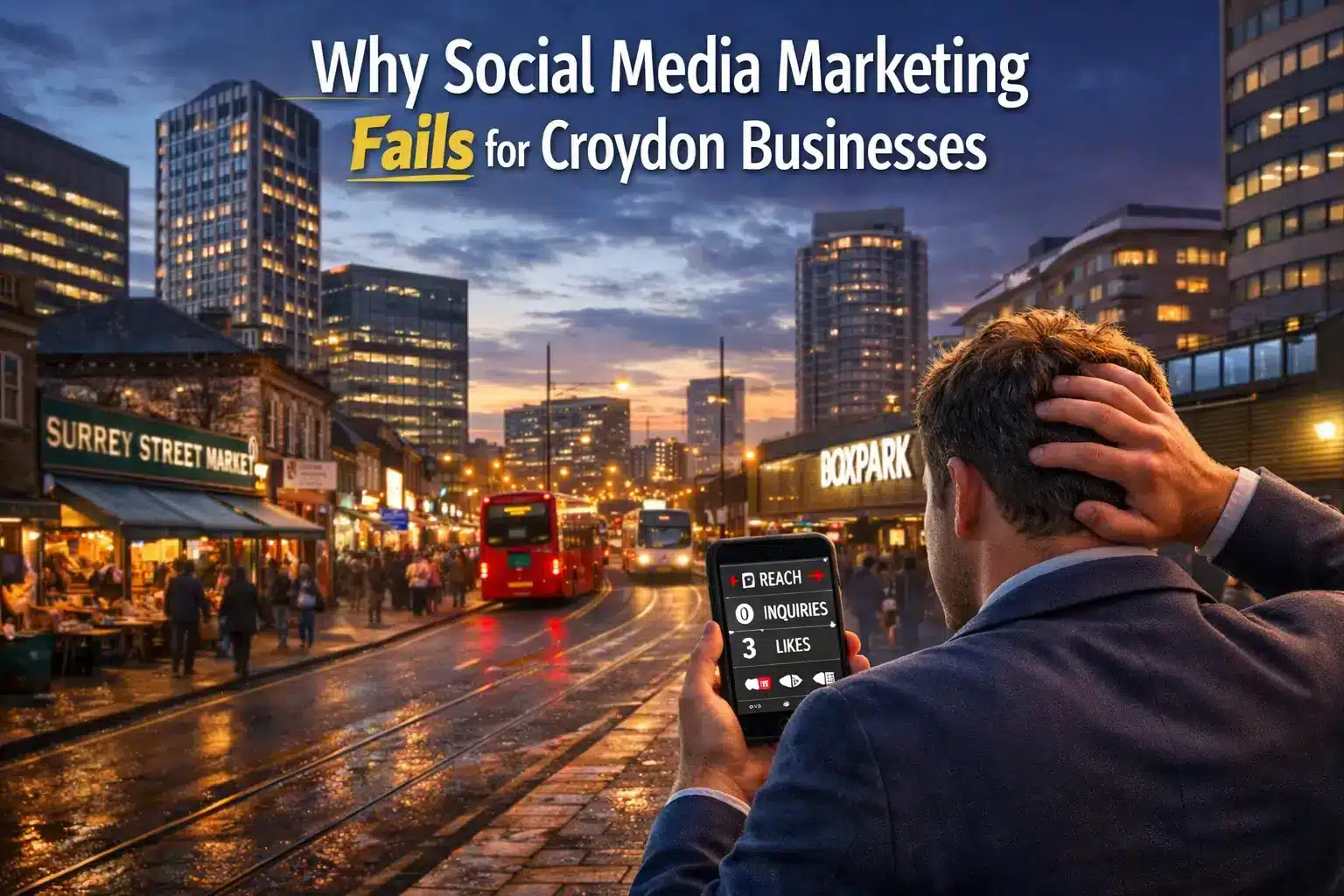

Social media marketing fails for many Croydon businesses for one simple reason: activity is not the same as customer intent. A business can post regularly, gain likes and even run ads, yet still receive very few enquiries if the message, audience, website and follow-up journey do not work together.
This guide explains where that breakdown usually happens and how to fix it without chasing every new platform trend.
Social media should create attention and trust. Your wider marketing system has to turn that attention into enquiries.
If the audience is wrong, the offer is vague, the landing page is weak or the website does not convert, more posting usually creates more activity rather than more customers.
Why Croydon businesses struggle to turn social media into enquiries
Reach looks healthy, but too few people are realistic buyers.
People see the post but still do not understand the service or why it matters.
The click lands on a generic homepage or confusing page.
Likes are counted, but calls, forms and sales are not attributed.
1. Posting without a commercial purpose
Many local businesses begin with the wrong question: What should we post today?
A better question is: What should the right customer understand, believe or do after seeing this?
A plumber in Selsdon, a solicitor in central Croydon and a café near East Croydon need different content because their customers have different levels of urgency, trust requirements and buying behaviour.
Content should support a specific job: demonstrate expertise, show proof, answer objections, promote an offer, generate a visit, encourage a call or move someone towards a service page.
2. Focusing on followers instead of potential customers
A larger audience is not automatically a better audience. For a Croydon service business, a smaller group of relevant local people can be far more valuable than thousands of followers who will never buy.
Useful questions include:
- How many website visits came from social media?
- Which posts produced calls, forms, bookings or sales?
- Which location and audience segments responded?
- Which content helped people move towards a commercial page?
Measure the behaviour closest to revenue rather than treating engagement as the final outcome.
3. The service is not clear enough
A social profile should make it easy to understand what the business does, who it helps and where it operates.
Vague branding may look polished while leaving the customer unsure whether the service is relevant. Strong local marketing is usually specific: service, audience, location, proof and next step.
4. Content creates attention but no reason to act
Educational posts are useful, but information alone does not always create an enquiry. The customer needs a logical next step.
That does not mean every post needs a hard sell. It means the content should fit a journey: discover the business, understand the problem, see evidence, compare options and then act when ready.
The right person sees you.
They know what you offer.
They see proof and relevance.
They call, book or enquire.
5. Social ads are sending people to the wrong page
A strong ad can still fail after the click.
Sending every campaign to a generic homepage often creates a mismatch between the ad promise and the page the visitor lands on. Paid traffic usually performs better when the destination continues the same message, answers buying questions and gives one obvious next step.
Our guide to service pages that rank and convert explains the same principle for search traffic.
6. The website is leaking the interest social media creates
Sometimes social media is doing its job. The customer clicks through, then encounters a slow page, vague headline, poor mobile experience, weak proof or a form that asks too much.
That is not a social-media problem. It is a conversion problem.
If your site receives visitors but too few become enquiries, see our guide to getting more leads from existing website traffic.
7. Croydon businesses rely on social media but ignore search intent
Social media is useful for discovery and trust. Search captures a different moment: the customer is actively looking for a solution.
A person searching for a local service on Google may be much closer to making a decision than someone casually scrolling a feed.
That is why social media works best alongside a strong website, local SEO and an accurate Google Business Profile rather than replacing them.
8. The content could belong to any business in any city
Local content should feel genuinely local, not because the word “Croydon” is repeated in every paragraph, but because the examples, services, projects, customer problems and proof reflect the area the business actually serves.
Useful local signals might include real work in Croydon, relevant neighbourhoods, local customer questions, team photos, community involvement or genuine location-specific case studies.
Avoid fake local relevance. A picture of a landmark with no connection to the business does not substitute for evidence.
9. Businesses use too many platforms badly
You do not need to be active everywhere.
A professional service may find LinkedIn valuable. A salon or restaurant may get more value from Instagram or Facebook. A trade business may benefit from Facebook, local community channels and short-form project evidence.
The right platform depends on the customer, not on whichever network is currently receiving the most attention.
10. Nobody follows up the lead properly
Generating an enquiry is only part of the job. Slow replies, missed form emails and unclear follow-up can waste leads that marketing worked hard to create.
Test forms, inbox routing, phone handling and response times regularly. If a customer submits an enquiry and hears nothing, the marketing channel may be blamed even though the real failure happened afterwards.
What should Croydon businesses measure?
Track a small set of outcomes that connect activity with business value:
- website sessions from each platform
- calls, forms, messages, bookings or purchases
- cost per qualified enquiry for paid campaigns
- landing-page conversion rate
- which posts assist later enquiries or branded searches
- response time after an enquiry arrives
Platform engagement can still be useful as a diagnostic signal, but it should not be mistaken for revenue.
How social media, SEO and your website should work together
Think of the three channels as different parts of the same system.
- Social media builds familiarity, proof and repeated exposure.
- SEO and Google Search capture people actively researching a service.
- Your website explains the offer, answers buying questions and converts interest into action.
For a broader view of how those channels fit together, see our digital marketing guide for small businesses.
If attention, trust, search intent and conversion are disconnected, posting more often rarely fixes the underlying problem.
When should a Croydon business get professional social media help?
Professional help becomes more useful when content is taking time but producing no measurable outcome, ads are spending without qualified enquiries, the business cannot maintain a sensible content system, or nobody is connecting social activity to website and search performance.
See our social media management service in Croydon if you want help building that wider system around measurable enquiries rather than posting for the sake of activity.
Frequently asked questions
Does social media marketing still work for Croydon businesses?
Yes, but its role varies by business. It can be effective for awareness, trust, remarketing, community visibility and lead generation when the audience, message, destination and follow-up process are aligned.
Is social media better than local SEO?
They solve different problems. Social media can create demand and familiarity, while local SEO helps capture people who are already searching. Many local businesses benefit from using both.
How often should a local business post?
There is no universal number. A sustainable schedule of useful, original content is better than publishing frequently with no clear purpose.
Should a Croydon business use paid social advertising?
It can make sense when the audience, offer, tracking and landing page are strong. Paid traffic does not fix a weak customer journey.
Final takeaway
Social media usually fails when it is treated as a standalone activity. For Croydon businesses, the stronger approach is to connect local content, commercial intent, search visibility, a persuasive website and reliable follow-up into one customer journey.