


Google’s May 2026 Core Update officially finished rolling out on June 2 after nearly two weeks of heavy ranking volatility across multiple industries.
For many businesses, this update felt different from previous core updates. It arrived shortly after Google I/O announcements focused heavily on AI-powered search experiences, AI Overviews, and Gemini-powered search infrastructure.
While Google has not confirmed every ranking factor involved in the update, many SEO professionals and website owners observed stronger visibility shifts around mobile performance, crawl efficiency, structured data quality, and overall site architecture.
The broader message is becoming clearer: modern search is no longer focused only on keywords and backlinks. Google increasingly needs websites that are fast, machine-readable, technically clean, and easy for AI systems to understand.
Why the May 2026 Core Update matters
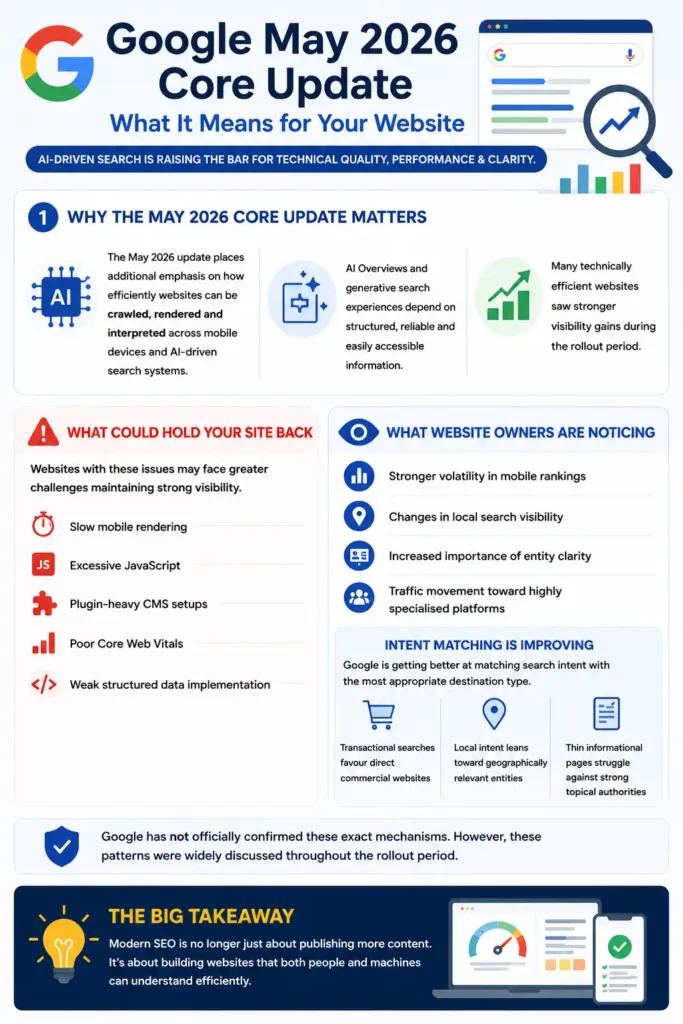
Most core updates adjust how Google evaluates content quality and relevance.
The May 2026 update appeared to place additional emphasis on how efficiently websites can be crawled, rendered, and interpreted across mobile devices and AI-driven search systems.
This matters because AI Overviews and generative search experiences depend heavily on structured, reliable, and easily accessible information.
In practical terms, websites with:
- slow mobile rendering,
- excessive JavaScript,
- plugin-heavy CMS setups,
- poor Core Web Vitals,
- or weak structured data implementation
may now face greater challenges maintaining strong visibility in competitive search results.
At the same time, many technically efficient websites appeared to gain stronger positioning during the rollout period.
What website owners are noticing
Across several industries, website owners reported:
- stronger volatility in mobile rankings,
- changes in local search visibility,
- increased importance of entity clarity,
- and traffic movement toward highly specialised platforms.
Many SEO analysts also observed that Google seemed better at matching search intent with the most appropriate destination type.
For example:
- transactional searches increasingly favoured direct commercial websites,
- local intent queries leaned more toward geographically relevant entities,
- and thin informational pages struggled against stronger topical authorities.
Again, Google has not officially confirmed these exact mechanisms. However, these patterns were widely discussed throughout the rollout period.
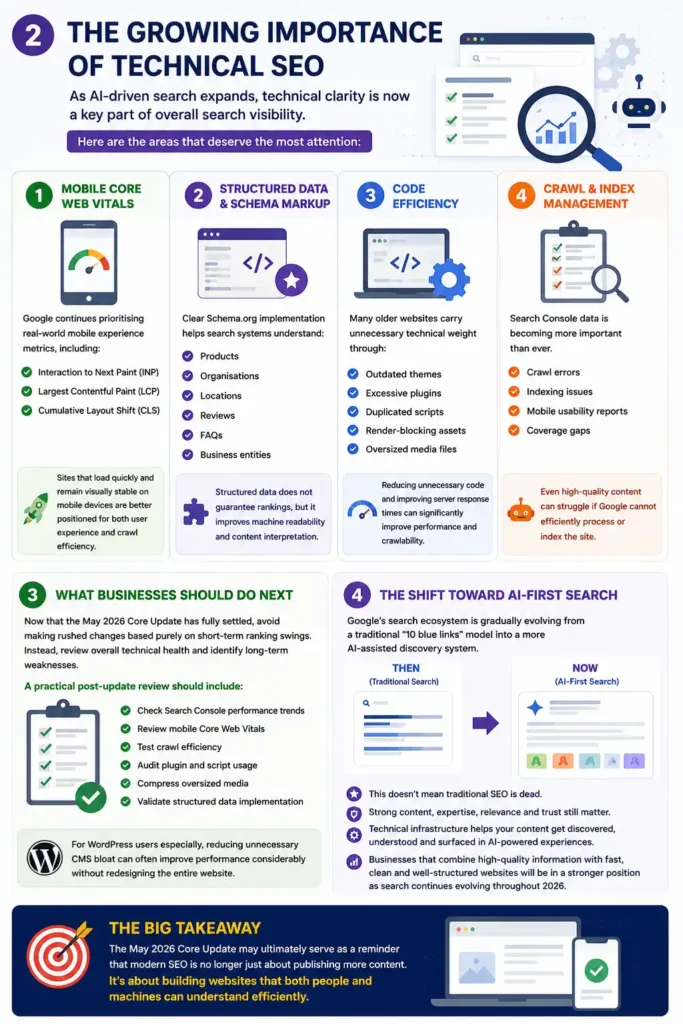
The growing importance of technical SEO
Technical SEO is no longer just a background maintenance task.
As AI-driven search expands, technical clarity is becoming part of overall search visibility.
Several areas now deserve closer attention:
Mobile Core Web Vitals
Google continues prioritising real-world mobile experience metrics, including:
- Interaction to Next Paint (INP),
- Largest Contentful Paint (LCP),
- and Cumulative Layout Shift (CLS).
Sites that load quickly and remain visually stable on mobile devices are generally better positioned for both user experience and crawl efficiency.
Structured data and schema markup
Clear Schema.org implementation helps search systems understand:
- products,
- organisations,
- locations,
- reviews,
- FAQs,
- and business entities.
Structured data does not guarantee rankings, but it improves machine readability and content interpretation.
Code efficiency
Many older websites carry unnecessary technical weight through:
- outdated themes,
- excessive plugins,
- duplicated scripts,
- render-blocking assets,
- or oversized media files.
Reducing unnecessary code and improving server response times can significantly improve both performance and crawlability.
Crawl and index management
Search Console data is becoming more important than ever.
Website owners should regularly review:
- crawl errors,
- indexing issues,
- mobile usability reports,
- and coverage gaps.
Even high-quality content can struggle if Google cannot efficiently process or index the site.
What businesses should do next
Now that the May 2026 Core Update has fully settled, businesses should avoid making rushed changes based purely on short-term ranking swings.
Instead, the smarter approach is to review overall technical health and identify long-term weaknesses.
A practical post-update review should include:
- checking Search Console performance trends,
- reviewing mobile Core Web Vitals,
- testing crawl efficiency,
- auditing plugin and script usage,
- compressing oversized media,
- and validating structured data implementation.
For WordPress users especially, reducing unnecessary CMS bloat can often improve performance considerably without redesigning the entire website.
The shift toward AI-first search
Google’s search ecosystem is gradually evolving from a traditional “10 blue links” model into a more AI-assisted discovery system.
That does not mean traditional SEO is dead.
Strong content, expertise, relevance, and trust still matter enormously.
But technical infrastructure is increasingly supporting how effectively that content can be discovered, interpreted, and surfaced within AI-powered search experiences.
Businesses that combine high-quality information with fast, clean, well-structured websites are likely to be in a stronger position as search continues evolving throughout 2026.
For website owners, the May 2026 Core Update may ultimately serve as a reminder that modern SEO is no longer just about publishing more content.
It is about building websites that both people and machines can understand efficiently.