
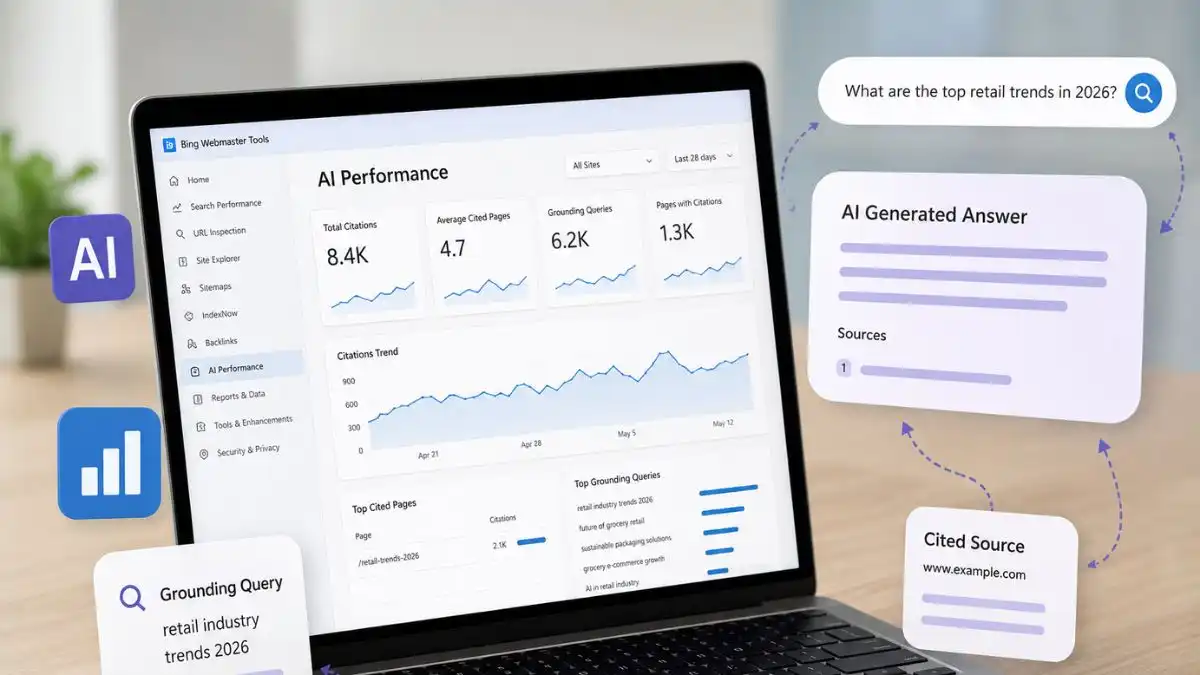

Microsoft has expanded Bing Webmaster Tools with a new AI Performance dashboard, giving publishers, businesses, and website owners a clearer view of how their content is used in AI-generated answers.
The update marks one of the most significant changes to search analytics since the rise of generative AI. While website owners have traditionally relied on rankings, impressions, and clicks to measure performance, the new dashboard introduces visibility into how content is cited and referenced within AI-powered experiences.
The launch reflects a broader shift in search behavior as users increasingly turn to AI assistants and conversational search tools for answers.
Rather than directing users to a list of links, AI systems often combine information from multiple sources to generate a single response. Until now, publishers had little visibility into whether their content was helping shape those answers.
New metrics for the AI search era
The AI Performance dashboard introduces several reporting features designed to help website owners understand how their content is performing within Microsoft’s AI ecosystem.
Among the new metrics are Total Citations, which tracks how often content is referenced in AI-generated responses, and Average Cited Pages, which shows how many pages from a website are being used as sources.
Microsoft has also introduced Grounding Queries, a feature that reveals the search phrases and information requests used by AI systems when retrieving content. Publishers can use this data to better understand how AI tools connect user intent with information published on their websites.
Page-level citation reporting provides another layer of visibility by identifying which individual pages receive the most AI citations.
Together, these reports offer insights that were previously unavailable through traditional search analytics platforms.
Why the update matters
The biggest change is not the dashboard itself but what it reveals.
For years, digital success was measured primarily through website traffic. Higher rankings often led to more clicks, and more clicks typically translated into greater visibility.
AI-powered search changes that model.
A website can now influence a user’s answer without generating a visit. An AI assistant may use information from multiple sources to create a response, meaning content can shape decisions, recommendations, and research outcomes even when no click occurs.
The new reporting tools help quantify that influence.
For publishers, this introduces a new performance layer alongside traditional SEO metrics. Content authority is no longer measured only by rankings and traffic but also by how frequently information is selected and cited by AI systems.
A shift from rankings to citations
The update highlights a growing trend across the search industry.
As AI-generated answers become more common, citations may become an increasingly important indicator of authority and trustworthiness.
Publishers that consistently provide accurate, well-structured, and authoritative information could see stronger citation activity within AI experiences, even if referral traffic patterns change over time.
The introduction of query-to-page mapping further helps publishers identify which content pieces are contributing most effectively to AI-generated answers.
This allows content teams to understand not only what users are searching for but also how AI systems interpret and retrieve information.
What changes for content creators?
The new reporting tools are likely to encourage publishers to focus more heavily on content clarity, structure, and topical authority.
Clear headings, concise explanations, factual information, and well-organized content may become increasingly valuable as AI systems continue to retrieve and summarize information from across the web.
The dashboard also gives publishers an opportunity to identify content gaps, discover emerging search patterns, and understand which pages are gaining visibility through AI-generated responses.
While traditional SEO metrics remain important, the ability to measure AI citations adds a new dimension to digital performance analysis.
What happens next?
Microsoft’s AI Performance dashboard signals that AI visibility is becoming a measurable part of search strategy.
As generative AI continues to influence how people discover information online, publishers are likely to monitor both traditional traffic metrics and AI citation data to evaluate content performance.
The update provides an early glimpse into how search measurement may evolve in the years ahead, as the industry moves beyond rankings and clicks toward a broader understanding of digital influence.
For publishers, the message is becoming increasingly clear: content value is no longer defined solely by who clicks on it, but also by how often it helps power the answers people receive from AI systems.