
Millions of website owners have seen a sharp decline in organic traffic during 2026. For some publishers, losses have been gradual. For others, traffic disappeared almost overnight.
The reasons are not limited to one Google update or a single technical issue. Search itself is changing. Artificial intelligence is answering more questions directly, users are increasingly turning to AI assistants instead of traditional search engines, and Google’s ranking systems continue to reward websites that demonstrate genuine expertise and authority.
For businesses that depend on search traffic, understanding these changes has become essential.
At a Glance
- Google AI Overviews are reducing clicks to many websites.
- AI assistants are changing how people search for information.
- Zero-click searches continue to grow.
- Google is placing greater emphasis on authority and trust.
- Older and thin content is losing visibility.
- Technical issues still play a major role in traffic declines.
- Building a strong brand is becoming more important than ranking for individual keywords.
What Is Causing Website Traffic to Drop in 2026?
There is no single answer.
Website traffic declines in 2026 are usually caused by a combination of factors, including Google’s AI-powered search experience, changing user behaviour, content quality issues, technical problems and increasing competition.
Many websites that relied heavily on informational search traffic are finding that users no longer need to click through to get basic answers.
Are Google AI Overviews Reducing Website Traffic?
For many publishers, the answer is yes.
Google’s AI Overviews now provide direct answers to a growing number of searches. Instead of showing a list of blue links, Google increasingly summarises information directly on the search results page.
For users, this can be helpful because they receive answers more quickly.
For publishers, however, it often means fewer clicks.
Websites covering topics such as definitions, travel information, recipes, health advice and simple how-to guides have been among the most affected.
A page may still rank on the first page of Google, but if an AI-generated answer satisfies the user’s question, fewer people have a reason to visit the website.
What Is Google AI Mode and Why Does It Matter?
Google’s AI Mode takes search one step further.
Instead of displaying a traditional list of results, AI Mode encourages users to have conversations with Google’s AI assistant. Users can ask follow-up questions, compare information and receive recommendations without leaving Google’s ecosystem.
This changes the way people interact with search.
Search journeys that once generated several website visits may now end inside Google’s AI interface.
For publishers, this means traffic patterns are changing fundamentally.
Are Zero-Click Searches Getting Worse?
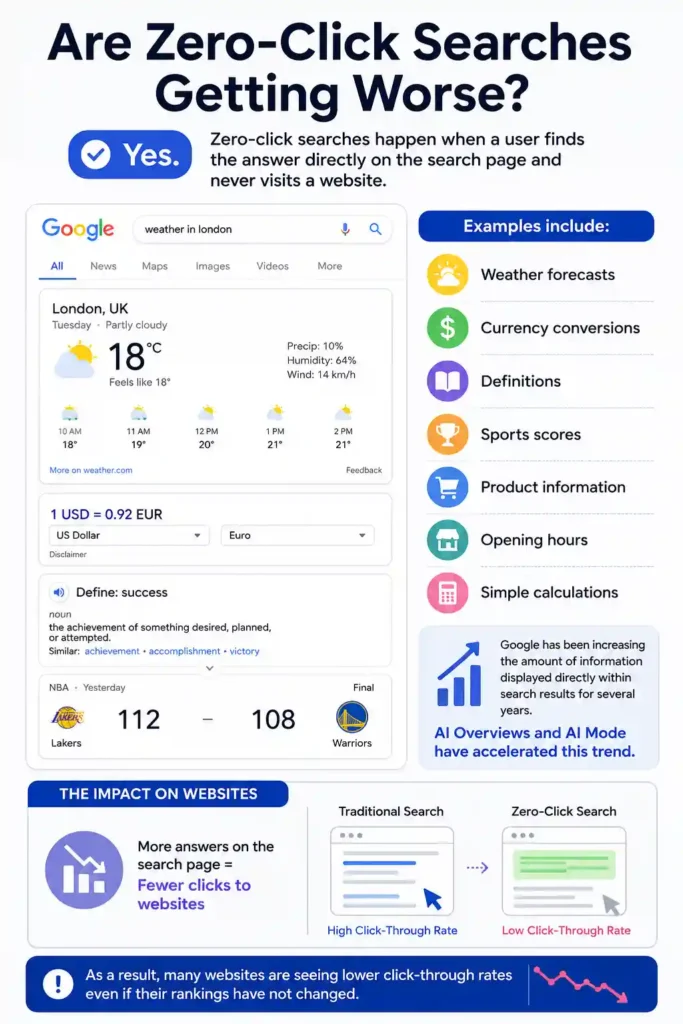
Yes.
Zero-click searches happen when a user finds the answer directly on the search page and never visits a website.
Examples include:
- Weather forecasts
- Currency conversions
- Definitions
- Sports scores
- Product information
- Opening hours
- Simple calculations
Google has been increasing the amount of information displayed directly within search results for several years. AI Overviews and AI Mode have accelerated this trend.
As a result, many websites are seeing lower click-through rates even if their rankings have not changed.
Did a Google Core Update Hurt Your Website?
Google continues to release core updates designed to improve search quality.
These updates increasingly favour websites that demonstrate:
- Experience
- Expertise
- Authority
- Trustworthiness
Websites with thin content, outdated information or weak authority signals are finding it more difficult to maintain rankings.
Many publishers who experienced traffic declines in 2026 discovered that competitors with stronger brands and deeper expertise gained visibility following recent algorithm updates.
Ranking today is about much more than keywords.
Google wants to recommend sources that users trust.
Has User Behaviour Changed?
Absolutely.
Millions of people now use AI tools such as ChatGPT, Gemini and other conversational assistants to find information.
Instead of searching:
“Best CRM software”
Users may ask:
“What is the best CRM for a small business with five employees?”
AI assistants provide immediate answers, recommendations and summaries.
This behavioural shift means some searches never reach Google at all.
Publishers are no longer competing only against other websites. They are competing for attention across an entire AI ecosystem.
Is Your Content Becoming Outdated?
Content freshness matters more than many publishers realise.
Articles written several years ago often contain:
- Outdated statistics
- Broken links
- Old screenshots
- Missing information
- Obsolete advice
Google prefers content that remains accurate and useful.
Regular content updates can often improve rankings and restore lost traffic.
Many websites experiencing declines in 2026 have simply failed to refresh important content.
Are Technical Problems Causing the Traffic Drop?
Sometimes the problem is not content.
Technical SEO issues can significantly reduce visibility.
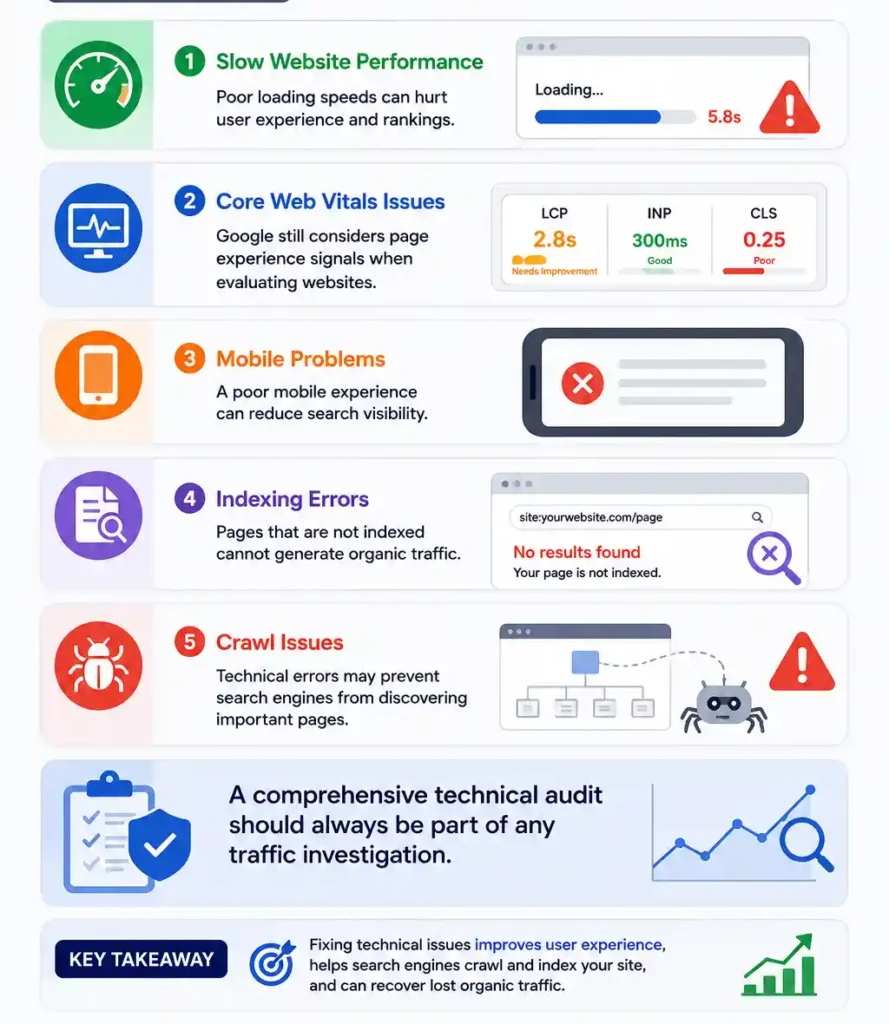
Common problems include:
Slow Website Performance
Poor loading speeds can hurt user experience and rankings.
Core Web Vitals Issues
Google still considers page experience signals when evaluating websites.
Mobile Problems
A poor mobile experience can reduce search visibility.
Indexing Errors
Pages that are not indexed cannot generate organic traffic.
Crawl Issues
Technical errors may prevent search engines from discovering important pages.
A comprehensive technical audit should always be part of any traffic investigation.
Which Industries Are Losing the Most Traffic?
| Industry | Traffic Risk in 2026 |
|---|---|
| News Publishers | Very High |
| General Information Sites | Very High |
| Health Content | High |
| Travel Websites | High |
| Educational Content | High |
| E-commerce | Medium |
| Local Businesses | Medium |
| B2B Websites | Lower |
Industries that rely heavily on informational queries have generally seen the greatest disruption from AI-powered search experiences.
How Can You Recover Lost Website Traffic?
Recovery is possible, but the strategies that worked five years ago are becoming less effective.
Build Topical Authority
Create comprehensive coverage around your area of expertise.
Publish Original Information
Research, surveys and exclusive data are increasingly valuable.
Strengthen E-E-A-T Signals
Show who created the content and why they are qualified.
Optimise for AI Citations
Create clear, factual content that AI systems can easily reference.
Update Existing Content
Refreshing old articles can improve rankings and user trust.
Diversify Traffic Sources
Relying entirely on Google search has become increasingly risky.
Email newsletters, social media, communities and direct traffic are becoming more important.
Improve Technical SEO
Fast, accessible and well-structured websites still perform better over the long term.
Why Building a Brand Matters More Than Ever
One of the biggest shifts in 2026 is the growing importance of brand recognition.
Google and AI systems increasingly favour sources that are already trusted.
Users are also more likely to click on websites they recognise.
A strong brand can help protect traffic during algorithm changes and improve visibility across both traditional and AI-powered search experiences.
What Happens Next?
Website traffic recovery in 2026 is no longer just about ranking for more keywords.
The future belongs to websites that:
- Demonstrate expertise.
- Publish original information.
- Build trust and authority.
- Create audiences beyond Google.
- Adapt to AI-powered search experiences.
Organic search is not disappearing, but it is changing rapidly.
The websites that succeed in the coming years will be those that treat search traffic as part of a broader digital strategy rather than their only source of visitors.