
Getting more website traffic is often seen as the quickest path to business growth. Companies invest heavily in search engine optimization (SEO), paid advertising, email marketing, and social media to attract more visitors. While those channels are important, they only solve part of the problem.
If your website already attracts qualified visitors but only a small percentage become customers, adding more traffic may simply increase the number of people who leave without taking action. Imagine pouring water into a bucket with holes in the bottom. No matter how much water you add, much of it leaks away before the bucket fills. The same thing happens when a website has poor messaging, confusing navigation, slow pages, or ineffective calls to action.
This is where Conversion Rate Optimization (CRO) becomes valuable. Instead of focusing only on attracting more visitors, CRO improves the percentage of existing visitors who become leads. Even small improvements in conversion rates can generate significantly more enquiries, demo requests, or sales without increasing marketing spend.
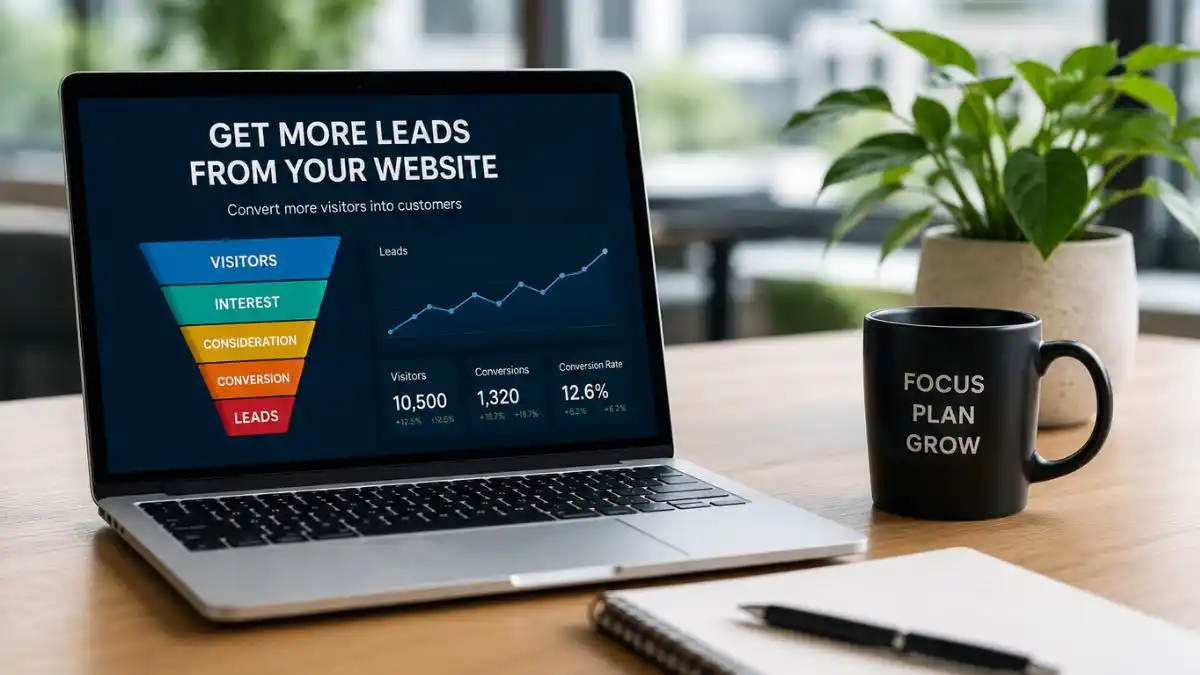
Whether you run a B2B company, an online store, or a local service business, the goal is the same: make every visitor count. This guide explains how to Get More Leads from Your Website by fixing the leaks in your conversion funnel, reducing friction, and creating a better user experience.
At a Glance
High-converting websites share several common characteristics:
- A clear value proposition that visitors understand within seconds.
- Content matched to search intent.
- Dedicated landing pages for marketing campaigns.
- Fast-loading pages on desktop and mobile.
- Simple forms with minimal friction.
- Trust signals placed throughout the customer journey.
- Analytics that identify conversion bottlenecks.
- Ongoing testing and optimization.
Improving these areas can increase lead generation without spending more on traffic acquisition.
Website Traffic vs. Website Conversions
Many businesses measure website success by traffic alone. Higher rankings, more page views, and increased ad clicks certainly indicate visibility, but they do not guarantee business growth.
Consider two companies.
| Company A | Company B | |
|---|---|---|
| Monthly visitors | 100,000 | 40,000 |
| Conversion rate | 1% | 4% |
| Monthly leads | 1,000 | 1,600 |
Although Company B attracts less than half the traffic, it generates substantially more leads because its website converts visitors more effectively.
This is the purpose of Conversion Rate Optimization (CRO): improving the percentage of visitors who complete valuable actions.
Macro vs. Micro Conversions
Not every visitor is ready to contact your sales team immediately. Successful websites measure both primary and secondary actions.
| Macro-Conversions | Micro-Conversions |
|---|---|
| Demo request | Newsletter signup |
| Contact form | Guide download |
| Quote request | Webinar registration |
| Product purchase | ROI calculator |
| Consultation booking | Pricing page visit |
Micro-conversions keep potential customers engaged until they are ready for a larger commitment.
The Leaky Bucket Framework
Think of your website as a bucket.
Marketing channels such as Google Search, paid advertising, social media, referrals, and email campaigns pour visitors into the top.
If the bucket has holes, visitors leak out before becoming leads.
Those leaks might include:
- Unclear messaging
- Slow-loading pages
- Weak calls to action
- Long forms
- Poor mobile usability
- Lack of trust
Many businesses respond by buying more traffic instead of fixing the leaks. As advertising costs continue to rise, this becomes increasingly expensive.
Improving your conversion rate increases the value of every visitor you already attract, lowers customer acquisition costs, and improves the return on your existing marketing investment.
Why Websites Lose Potential Customers
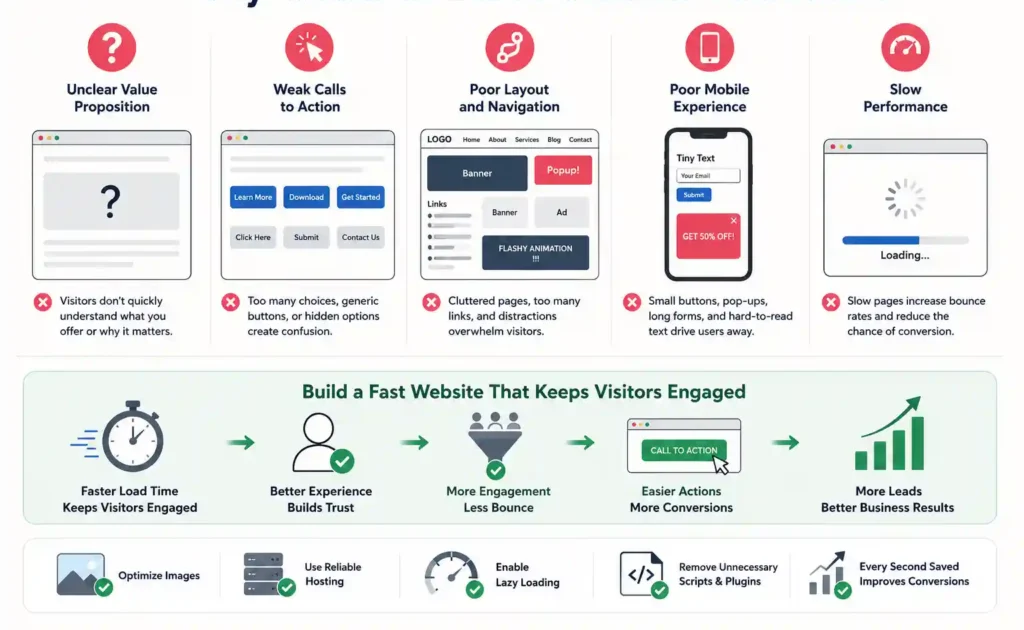
Most visitors do not leave because of one major problem. Instead, several small frustrations accumulate until leaving becomes easier than continuing.
Unclear Value Proposition
Visitors decide within seconds whether your website is relevant.
Your homepage or landing page should immediately answer three questions:
- What do you offer?
- Who is it for?
- Why should someone choose you?
If visitors have to scroll, search, or interpret vague marketing language before finding those answers, many will leave.
Strong headlines focus on customer outcomes rather than company descriptions. Clear language consistently outperforms clever slogans because visitors value clarity over creativity.
Weak Calls to Action
Even interested visitors need guidance.
Common mistakes include:
- Too many competing buttons.
- Generic wording such as “Submit.”
- Hidden contact options.
- Multiple equally important offers.
Each page should have one primary goal.
Instead of asking visitors to choose between six different actions, guide them towards the logical next step.
Action-oriented wording such as Book a Consultation, Download the Guide, or Calculate Your Savings communicates immediate value and sets clear expectations.
Poor Layout and Navigation
Good design directs attention.
Poor design competes for it.
Pages overloaded with banners, animations, pop-ups, and navigation links create unnecessary cognitive load.
High-converting websites use clear visual hierarchy, generous spacing, concise copy, and obvious calls to action. Visitors should naturally move from headline to benefits, trust signals, and finally the conversion point.
Navigation should also support the visitor’s journey. Campaign landing pages work best when they remove unnecessary menu options and focus attention on a single objective.
Mobile Experience
Mobile visitors often have less patience than desktop users.
Common mobile problems include:
- Small buttons.
- Tiny form fields.
- Difficult-to-read text.
- Full-screen pop-ups.
- Slow loading pages.
A mobile-friendly website keeps forms short, makes buttons easy to tap, and ensures important calls to action remain visible throughout the browsing experience.
Testing your website on real mobile devices often reveals usability issues that desktop previews miss.
Build a Fast Website That Keeps Visitors Engaged
Website speed affects more than user satisfaction—it directly influences lead generation. Visitors expect pages to load quickly, and even short delays can increase bounce rates and reduce form completions.
Performance also shapes first impressions. A slow website can make a business appear outdated or unreliable before visitors have read a single sentence.
While developers focus on technical metrics such as Core Web Vitals, business owners should focus on the outcome: a faster website keeps visitors engaged for longer and makes it easier for them to take action.
You don’t need to rebuild your website to improve performance. Often, the biggest gains come from practical improvements such as compressing images, using reliable hosting, enabling lazy loading, and removing unnecessary scripts or plugins.
Every second saved reduces friction, improves the user experience, and helps visitors move further through the conversion journey.
Match Content to Visitor Intent
One reason websites struggle to convert is that they ask every visitor to take the same action.
Someone reading an educational blog post is rarely ready to book a sales call, while a visitor comparing products may want pricing or a demonstration. Understanding search intent helps you present the right offer at the right time.
Informational Intent
These visitors are researching a topic or looking for answers.
Instead of asking them to contact your sales team immediately, offer a low-commitment next step such as:
- Download a checklist.
- Subscribe to your newsletter.
- Access a buying guide.
- Read a related article.
These micro-conversions allow you to build a relationship before asking for a larger commitment.
Commercial Intent
Commercial visitors are evaluating different providers or solutions.
At this stage, they need information that helps them compare options confidently. Useful content includes customer case studies, product comparisons, FAQs, pricing guidance, and product demonstrations.
The most appropriate calls to action are usually Book a Demo, Request a Consultation, or Talk to an Expert.
Transactional Intent
Transactional visitors are ready to act.
Whether they want to request a quote, start a free trial, or make a purchase, every unnecessary distraction reduces the chance of conversion.
Pages targeting these visitors should focus on one offer, one audience, and one clear call to action.
Homepage vs. Landing Pages
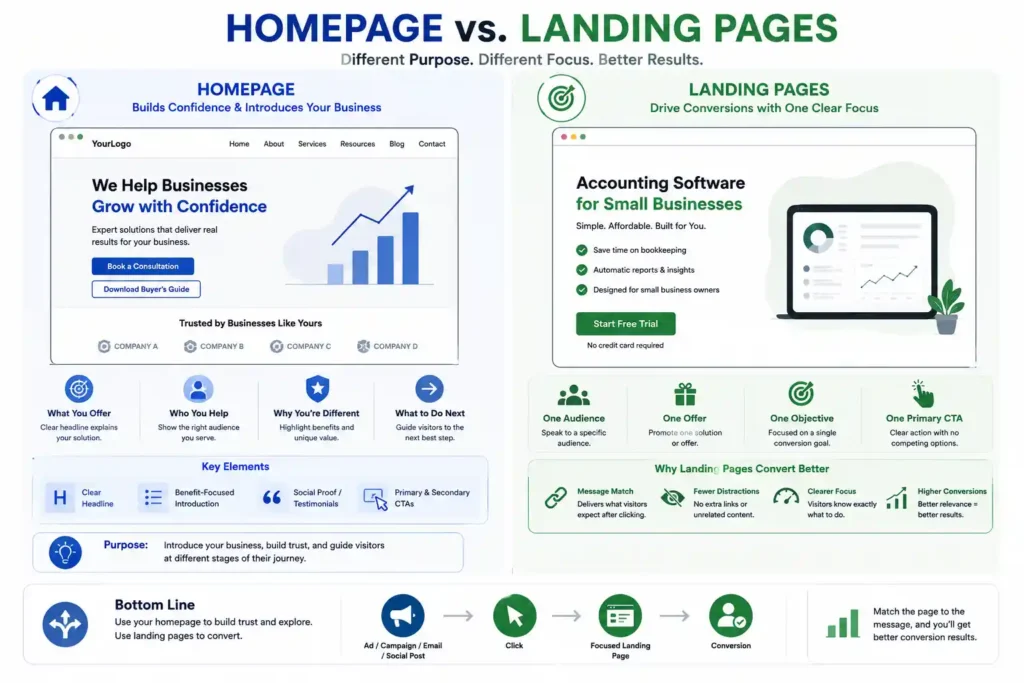
Although every business needs a strong homepage, it should not become the destination for every marketing campaign.
Each page serves a different purpose, and understanding that difference can significantly improve conversion rates.
Create a Homepage That Builds Confidence
Your homepage is often the first impression of your business.
Within a few seconds, visitors should understand:
- What your business offers.
- Who you help.
- Why your solution is different.
- What they should do next.
An effective homepage combines a clear headline, a benefit-focused introduction, visible customer proof, and a prominent call to action. It should guide visitors naturally toward the next step instead of overwhelming them with competing messages.
Offering both a primary CTA, such as Book a Consultation, and a secondary CTA, such as Download the Buyer’s Guide, helps serve visitors at different stages of the buying journey.
Why Dedicated Landing Pages Convert Better
Many businesses make the mistake of sending paid advertising, email campaigns, and social media traffic directly to the homepage.
This creates a disconnect between the visitor’s expectations and what they see after clicking.
For example, someone who clicks an advert promoting accounting software for small businesses expects to arrive on a page focused entirely on that solution—not a homepage featuring multiple products, news articles, and unrelated services.
Dedicated landing pages solve this problem by maintaining message consistency from click to conversion.
The most effective landing pages focus on:
- One audience.
- One offer.
- One objective.
- One primary call to action.
They also remove unnecessary navigation and distractions, making it easier for visitors to complete the intended action.
Whether traffic comes from Google Ads, LinkedIn campaigns, email marketing, or organic search, matching the landing page to the original message usually produces higher conversion rates than sending everyone to the homepage.
Offer Better Ways to Capture Leads
A contact form is no longer the only way to generate enquiries. Today’s visitors expect faster, more interactive ways to engage with businesses.
Offering multiple conversion paths helps capture leads with different preferences and levels of buying intent.
Use Conversational Marketing
Some visitors have a simple question that prevents them from taking the next step. Live chat, AI-powered assistants, callback requests, and click-to-call buttons allow businesses to answer questions immediately and reduce hesitation.
These tools should support—not interrupt—the user experience. A helpful chat option available when needed is far more effective than an aggressive pop-up that appears seconds after a visitor arrives.
Offer Valuable Interactive Tools
Interactive content encourages visitors to engage before committing to a sales conversation.
Effective examples include:
- ROI calculators.
- Website audit tools.
- Savings calculators.
- Product recommendation quizzes.
- Readiness assessments.
- Product configurators.
These tools provide immediate value while helping businesses qualify potential customers more effectively.
Use Exit-Intent Offers Carefully
Exit-intent technology can recover visitors who are about to leave your website by presenting a relevant final offer.
Rather than displaying a generic sales message, offer something useful, such as a buying guide, industry report, or free checklist.
When used sparingly and thoughtfully, exit-intent offers can increase lead generation without harming the overall user experience.