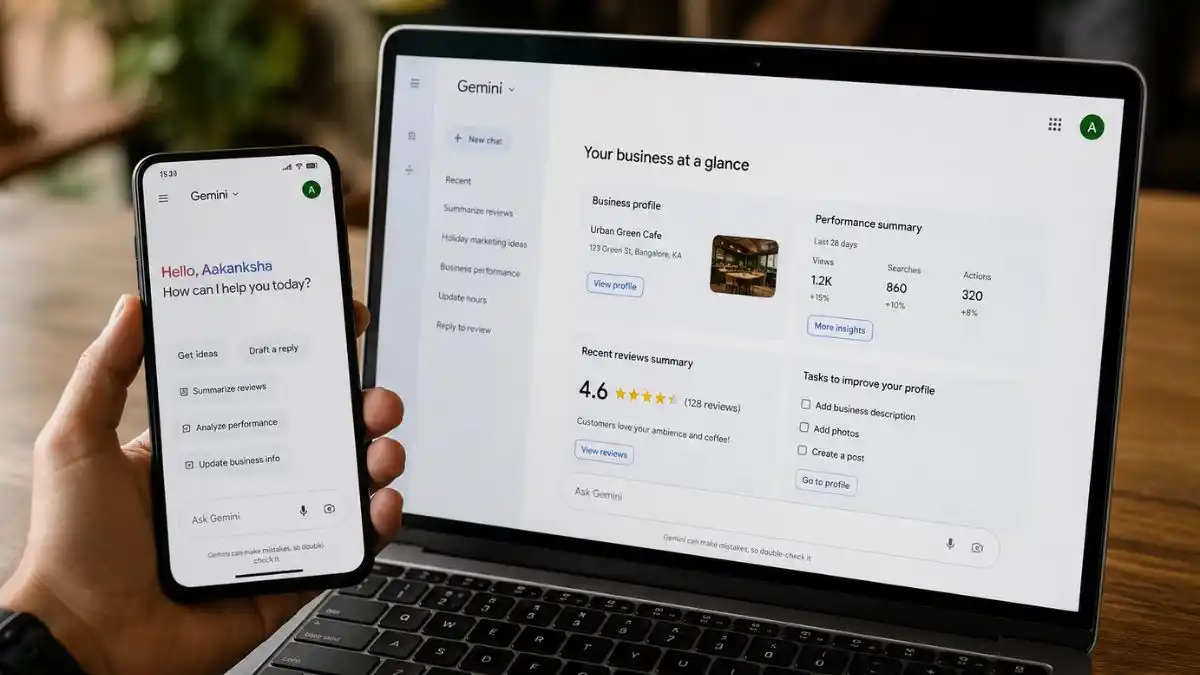
Google is testing AI Overview-style summaries inside some local business knowledge panels, potentially changing what searchers see before they visit a website, call a company or open its Google Business Profile.
The test was reported on 17 September by Search Engine Roundtable after local search specialist Ben Fisher shared the new interface and Barry Schwartz said he was able to reproduce it. The panel carries an “AI Overview” label and a “Show more” option that can open an AI Mode-style follow-up experience.
For UK small businesses, the important point is not that Google has announced a new local ranking system. It has not. This currently appears to be a search-interface test rather than a confirmed global rollout or ranking update. But it shows how Google may increasingly summarise a business before the customer reaches its website.
That makes the accuracy of the information Google can collect about a company more important. Google says Business Profile information can come from the business itself, public web content such as the company’s official website, third-party data and user contributions including reviews and photos. Its current local ranking guidance still says local results are mainly based on relevance, distance and prominence.
A business therefore should not react to the test by chasing an “AI Overview optimisation” trick. It should make sure its opening hours, categories, services, location details and contact information are accurate, while keeping the website consistent with the Business Profile. Core Web UK’s SEO services already treat website content and local visibility as connected rather than separate jobs.
The test also strengthens the case for maintaining useful first-party website content. If Google uses crawled web information alongside Business Profile data, an outdated services page or old company description can potentially feed an outdated picture of the business. Our guide to Google Business Profile and local SEO explains the fundamentals businesses should keep under control.
Search Engine Roundtable noted that one replicated AI summary contained mostly correct information but also reflected older content from the business website. That is a useful warning for companies whose sites have not been updated for years.
Google has not formally announced when, or whether, this version of local AI summaries will roll out more widely. For now, businesses should treat it as a significant test rather than a confirmed product change — and make sure the information Google already has about them is worth summarising.
How can local businesses prepare for AI Overviews?
Local AI results still depend on clear, trusted information. Your website and Google Business Profile should explain the service, location and business details in a way search systems can understand.
There is no need to create separate “AI pages”. Strong local SEO basics still matter.
- Keep business details consistent.
- Use clear service and location pages.
- Build real reviews and local proof.
- Answer common customer questions clearly.
A practical check for a UK business owner
Start with the business name, then a specific service-and-location query, then a genuine customer question about cost or suitability. These searches have different purposes and may show different features. Record what appears rather than assuming one result represents the whole market.
Keep these search features separate
- Local Pack or Maps: business listings and map-based discovery.
- A business knowledge panel: information about a particular business, including the reported AI-summary test.
- AI Overview or AI Mode: generated answers with supporting links that can vary between searches.
- Ordinary organic listings: links to website pages.
- Sponsored placements: advertisements, which are separate from an unpaid source citation.
An AI answer mentioning a business is not necessarily linking to its website. A Maps listing is not an ordinary organic position. An absent Overview in one search does not establish a site problem.
Copy this observation record
Query: the exact words searched.
Context: date, country/location, device and signed-in or signed-out state.
Feature: ordinary results, Maps, panel, AI Overview, AI Mode or ad.
Business mentioned: yes, no or unclear.
Linked source: the actual source URL, if shown.
Accuracy: correct information, outdated fact or unsupported claim.
Action: source to correct, owner, completion date and later check.
What to do if Google describes you incorrectly
Keep a dated screenshot and the exact query. Check your current website, Business Profile and any linked source for the disputed information. Correct information you control and use the relevant feedback or correction route for information you do not. Check again later; changing a source does not guarantee an immediate change to a generated answer.
State real service coverage without inventing branches, reviews or local project history. Give customers clear service details, current hours, contact information and honest cost factors. A regular posting schedule, a set number of landmark photos or extra schema is not a confirmed route to an AI citation.
What should an AI visibility review actually deliver?
Ask the supplier for dated observations, exact queries and source links, a factual accuracy review and a specific change list. Compare representative searches over time. Keep website Search Console clicks and impressions, Business Profile interactions and qualified enquiries separate. Calculate website CTR as clicks divided by impressions; a mention without a website click is a different observation, not a lead.
Google’s guidance for AI features and websites explains that the same SEO foundations apply, with no special AI files or schema required. Eligibility, inclusion, rankings and enquiries are not guaranteed. Preserve pages already working for customers while correcting demonstrated gaps.
