

Google has opened enrolment for its Play Catalog Access Program, allowing eligible third-party Android app stores in the United States to list apps from the Google Play catalog from 22 July 2026. Users will discover apps through participating stores, but downloads will still be completed through Google Play.
The programme gives independent Android marketplaces access to a much larger selection of apps. However, participating stores must pass Google’s security and policy reviews, obtain permission from developers and pay an annual $5,000 service fee.
What is the Play Catalog Access Program?
The Play Catalog Access Program enables approved third-party US Android app stores to display eligible apps available through Google Play.
When someone chooses one of these apps, Google’s Inline Install API will handle the installation. The download will therefore take place through Google Play under the same terms that apply when an app is downloaded directly from the Play Store.
Google Play service fees will continue to apply.
At a glance
- Enrolment opened on 22 July 2026.
- The programme is limited to Android app stores targeting US users.
- Participating stores can display apps from the Google Play catalog.
- App downloads will be completed through Google Play.
- Google’s existing service fee will still apply.
- App stores must secure written permission from developers.
- Participation costs $5,000 upfront and $5,000 annually.
Which app stores can apply?
Applicants must be registered organisations operating legitimate, consumer-facing Android marketplaces in the United States.
The app store’s main purpose must be helping users discover, install and manage apps. It must also have a user destination and launcher icon and be either pre-installed on a device or deliberately installed by the user.
Participating marketplaces must remain open to all eligible third-party developers under clear and non-discriminatory policies. They must also offer apps and games beyond those obtained solely through Play Catalog access.
This condition prevents businesses from creating a marketplace that simply reproduces Google’s catalog without developing a separate app offering of its own.
What information must stores show users?
Third-party stores must provide essential information for every app in their catalog. This includes the app’s name, developer, description, version, file size, permissions, legal disclosures and developer contact information.
Users must explicitly approve installations and ownership changes. Stores must also provide controls for choosing between automatic and manual app updates.
Google requires participating marketplaces to tell users that a catalog app comes from the Google Play Store before starting the installation process. This makes the source of the download clear, even when discovery takes place elsewhere.
What safety standards must app stores meet?
Participating stores must take active steps to stop malware, potentially harmful apps, fraud and illegal activity.
They must publish and enforce privacy policies, provide parental controls and follow applicable US requirements covering privacy, age assurance and the protection of children. Google specifically identifies laws such as the Children’s Online Privacy Protection Act and the California Consumer Privacy Act.
Each marketplace must also maintain an accessible customer support service and a process for addressing intellectual property disputes.
These requirements make security and compliance central to the application process. A marketplace needs more than a working storefront and an app catalog to qualify.
How can Play Catalog data be used?
Approved stores may use Play Catalog data only to operate their own marketplace in the United States.
They cannot share that information with another app store or use it for an unrelated purpose. Catalog data must not be presented in a misleading way.
Stores must update their listings against Google’s latest catalog snapshot every day or at least once a week. They are also prohibited from distributing Play Catalog apps outside the US.
A participating store cannot charge consumers an additional fee to download, install or use an app available only through Play Catalog access. It also cannot otherwise make money directly from installing those catalog apps.
How does the enrolment process work?
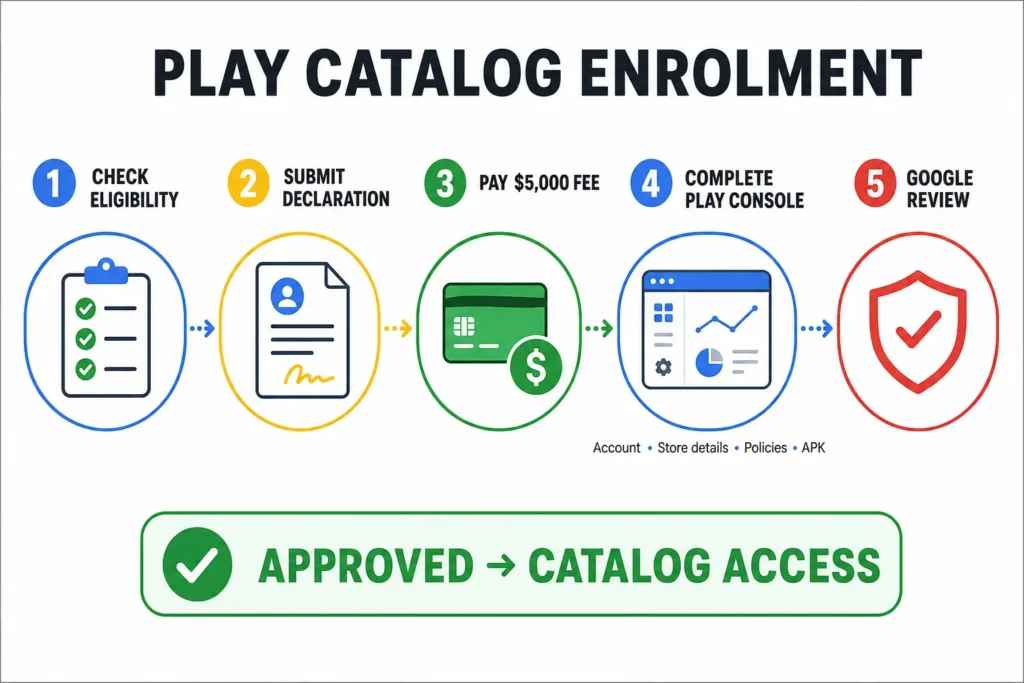
An app store operator must first check that its marketplace meets Google’s eligibility and operational requirements.
The organisation must then submit a declaration form, accept the programme’s service agreement and provide information about its store. It must pay the $5,000 onboarding fee before receiving access to the dedicated Play Console for app stores.
Google said this version of Play Console would become available in the coming weeks. Operators will use it to:
- Create an app store account.
- register the marketplace.
- add store information.
- submit policy declarations.
- upload the store’s Android application package.
- send the marketplace for review.
Catalog access will become available after Google approves the store and the programme becomes operational.
Why does this matter for app developers?
The programme could give developers another route through which US Android users can discover their apps. A developer’s product may appear inside an approved independent marketplace while Google Play continues to manage the final download.
However, an app store cannot assume that listing an application on Google Play automatically gives it the right to offer that app. It must obtain written authorisation from the developer and hold the necessary rights and permissions.
Developers should therefore review any distribution request carefully. They need to understand how their app will be presented, how users will receive support and how the third-party marketplace will handle branding, updates and customer information.
What does it mean for US businesses?
For businesses planning an Android marketplace, the programme reduces one important barrier: building a useful app catalog from the beginning.
Access does not remove the cost or complexity of operating an app store. Businesses will still need policies, customer support, developer agreements, privacy controls, technical maintenance and effective malware prevention.
The $5,000 annual charge may be manageable for established technology companies but could present a larger commitment for start-ups testing a new marketplace model.
For companies that depend on mobile apps, the change also makes distribution strategy more important. Businesses may need to decide whether appearing in additional marketplaces can improve reach without weakening control over their brand or customer experience.
A specialist web and app development agency can help businesses assess the technical, security and user-experience requirements before they invest in a new Android marketplace.
What happens next?
Google is preparing the Play Console for app stores and documentation for the Inline Install API. Both are expected to become available after the initial enrolment stage.
Approved operators will need to integrate the API and keep their catalog data current. They must also send Google every updated version of their app-store APK for review before releasing it to users, although they will not have to wait for that review to finish before publishing the update.
The first participating stores will gain catalog access once their applications are approved and the Play Catalog Access Program goes live.