AI search has changed what happens before somebody visits a business website. Google can answer questions directly in AI Overviews. ChatGPT, Gemini and Perplexity can summarise options, compare providers and surface information without a traditional list of ten blue links.
That does not make a business website less important. It changes what the website has to do.
Your site is still the place you control: the source of your service information, prices where you publish them, case studies, proof, policies, contact routes, conversion tracking and first-party customer journey. Search engines and AI systems can summarise the web, but they still need reliable sources to understand what a business does and whether the information is current.
The website’s job has changed from “get the click” to “be the source, prove the claim and convert the interest”.
A strong website now supports traditional search, Google Maps, AI-generated answers, paid campaigns, referrals and direct brand searches at the same time. It is not only a traffic destination; it is the business’s most controllable source of truth.
What changed when AI entered search?
For years, the standard model was simple:
search → ranking → click → website → decision.
Now the path can be:
question → AI answer → shortlist → brand search → website → decision.
Or:
Maps result → review check → website → call.
Or:
ChatGPT recommendation → direct visit → service page → enquiry.
The website has not disappeared from the journey. It has moved from being the only discovery surface to being the place where claims are verified and decisions are completed.
AI search still needs web sources
AI systems do not create reliable business facts from nowhere.
They draw on information available across the web, including websites, profiles, directories, reviews, publications and other structured sources.
If your website clearly states:
- what you do;
- where you operate;
- who you serve;
- what each service includes;
- how customers can contact you;
- what evidence supports your claims;
- who owns or runs the business;
you give search and AI systems a stronger factual base than a thin five-line homepage.
This is also why the fundamentals behind AI search visibility still overlap heavily with traditional SEO: crawlable pages, clear structure, useful content and consistent entities remain important.
Your website is the source you control
A social profile can change its reach. A directory can change its layout. Google can change how much information appears in a Business Profile. An AI answer can cite you one week and not the next.
Your website is different.
You control:
- the domain;
- the pages;
- the customer journey;
- the content depth;
- the calls to action;
- the tracking;
- the first-party data you collect lawfully;
- the proof customers see before contacting you.
That control is strategically valuable precisely because discovery is becoming more fragmented.
A Google Business Profile is important, but it is not a replacement website
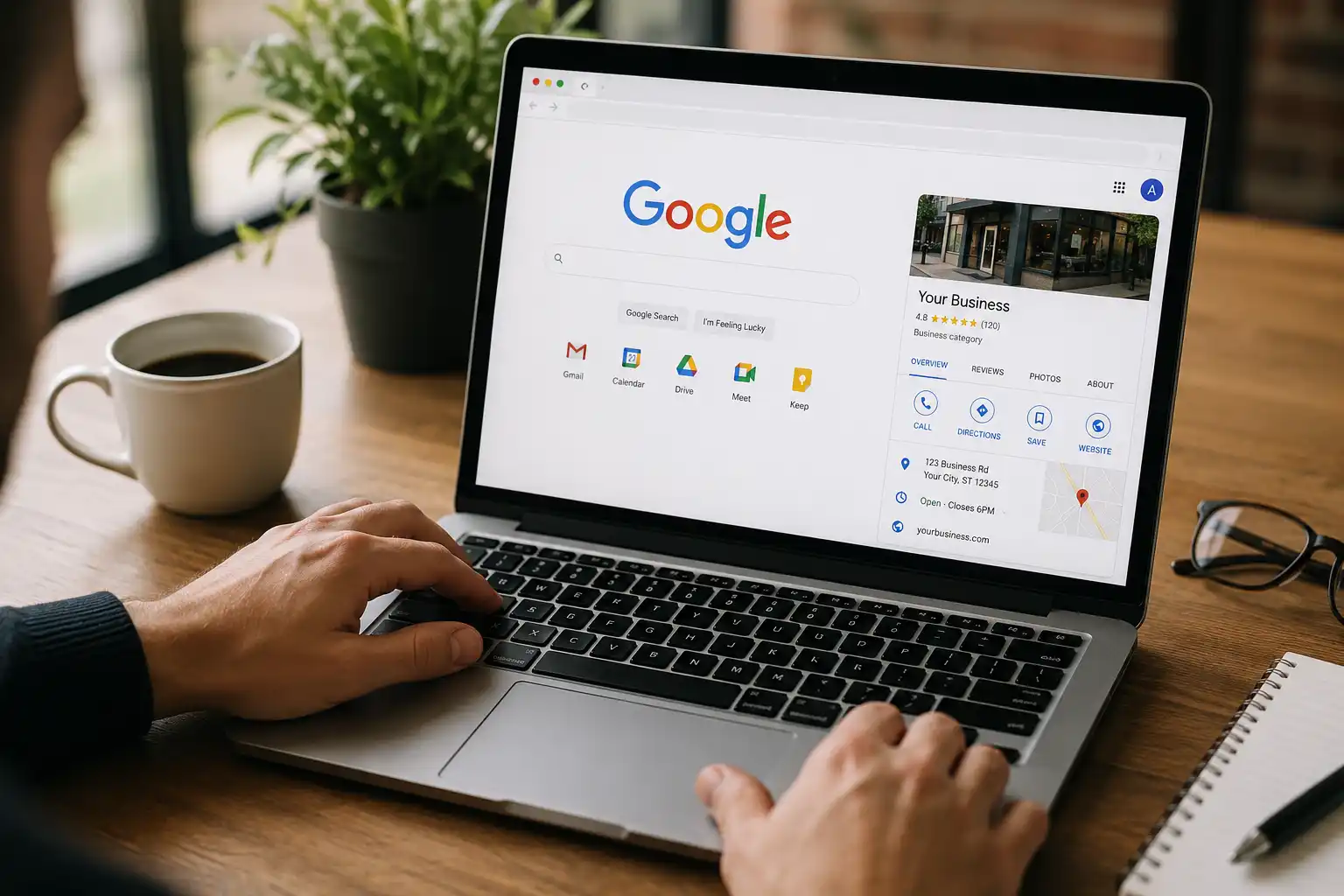
A strong Google Business Profile can show hours, reviews, photos, phone details, services and directions directly in Search and Maps.
But a profile has limited space to explain a complex service, compare options, show case studies, publish in-depth buying information or control the full enquiry journey.
For a local business, the strongest setup is usually profile + website working together.
The profile helps customers discover and evaluate the business quickly. The website provides depth, proof and conversion.
Why a website matters even when the customer never clicks from Google
Zero-click discovery does not mean zero website influence.
A customer may read a business name in an AI answer, then search the brand directly later. They may compare reviews, visit the site from Maps, ask a colleague about the company or open the domain from a social profile.
The website supports that whole chain because it gives the business a stable identity and detailed destination.
AI makes trust more important, not less
Generative AI makes it easier to create plausible-sounding content. That increases the value of evidence.
A credible business website should show things that are difficult to fake convincingly at scale:
- real projects;
- named people;
- specific service details;
- original photography;
- customer feedback;
- clear company details;
- policies;
- accurate contact information;
- consistent pricing or cost guidance where appropriate.
Generic copy is becoming cheaper. Specific proof is becoming more valuable.
The website is where conversion happens
An AI answer can mention a business. It cannot guarantee that the visitor becomes a customer.
The website controls the conversion path:
- headline;
- service explanation;
- pricing context;
- case studies;
- forms;
- click-to-call;
- booking;
- checkout;
- follow-up triggers;
- analytics.
That is why improving visibility without improving the website can simply send more people into a weak sales process.
Search traffic is not the only value of content anymore
A useful service guide can now perform several jobs:
- rank in normal organic search;
- support an AI-generated answer;
- give a salesperson something useful to send;
- answer a customer objection before a call;
- support internal linking;
- build topical context around a commercial page;
- help a returning visitor trust the business.
Judging every page only by direct organic clicks understates its wider role.
What kind of website content is useful in AI search?
The same content that helps people make decisions.
Clear service pages
Explain the service, who it is for, what is included, cost drivers, process, timing, limitations and next steps.
Comparison pages
When customers genuinely compare two options, give a balanced explanation of the trade-offs.
Problem-solving guides
Answer the questions customers ask before they know which service they need.
Original evidence
Case studies, first-hand examples and real project details create information that generic summaries cannot simply manufacture.
Strong company information
Make it easy to verify the business, people, location and experience behind the claims.
Answer important questions directly
AI retrieval and featured snippets both reward clarity.
If the heading asks “How much does website maintenance cost in the UK?”, the first paragraph underneath should give a useful range before spending five paragraphs introducing the topic.
Then add the nuance.
This answer-first structure works for humans too. Readers can get the headline answer immediately and continue when they need more detail.
Do not build separate low-quality pages just for AI
There is no need to create an “AI version” of every SEO page.
That risks duplication and cannibalisation.
Build one excellent page for the real search/customer intent and make it:
- clear;
- well structured;
- crawlable;
- factually consistent;
- well supported internally;
- useful enough to cite.
Core Web UK’s guide to Google Business Profile and local visibility is an example of where the website and local entity should reinforce each other rather than become separate competing strategies.
Your website also protects brand accuracy
AI systems can surface outdated or conflicting information when the web contains several versions of the same business details.
Keep the website’s factual information current:
- address;
- phone;
- opening hours;
- service areas;
- team;
- services;
- pricing where published;
- company name;
- important policies.
Then align major profiles and trusted listings with that source.
Why owning the domain matters
Your domain accumulates history.
Pages earn links. Customers remember the brand. Search engines learn the site architecture. Other websites cite the content. Email uses the domain. Advertising and analytics depend on it.
That compounding value is difficult to recreate inside a rented social profile.
A strong website makes every marketing channel work harder
The same site can support:
- SEO;
- Google Ads;
- Maps;
- AI search;
- email;
- LinkedIn;
- referrals;
- offline marketing;
- direct brand traffic.
If the website converts poorly, every acquisition channel becomes less efficient.
What should businesses measure now?
Do not look only at sessions.
Track:
- qualified enquiries;
- calls;
- bookings or sales;
- organic landing pages;
- brand searches;
- Google Business Profile interactions;
- AI mentions or citations where you measure them;
- conversion rate;
- which pages assist customer decisions.
Discovery is spreading across more surfaces, so measurement has to become broader too.
What should a small business website prioritise in 2026?
If the budget is limited, focus on fundamentals before chasing every new trend.
- Clear positioning. Say what you do, for whom and where.
- Strong commercial pages. Give each important service enough depth.
- Trust. Show proof, real people and real work.
- Mobile usability. Make contacting the business easy.
- Technical health. Keep pages crawlable, fast and stable.
- Consistent business information. Align the website and important profiles.
- Measurement. Know which pages create enquiries.
- Useful supporting content. Answer questions that genuinely influence buying decisions.
Does AI mean SEO is becoming pointless?
No. SEO is changing because the result page is changing.
Traditional organic rankings still matter, but visibility can now include citations, AI answers, local results, rich features and branded discovery.
The underlying work remains remarkably familiar: useful content, a technically accessible site, clear entities, authority, good user experience and evidence.
What happens if you rely only on third-party platforms?
You accept somebody else’s rules.
A platform can:
- change reach;
- increase advertising costs;
- restrict account access;
- change how listings appear;
- remove features;
- change what data you can measure.
A business should still use those platforms. The strategic mistake is letting them become the only place customers can verify and contact the company.
Frequently asked questions
Do businesses still need websites if Google gives answers directly?
Yes. A website remains the main source a business controls for detailed service information, proof, conversion, tracking and brand verification.
Can ChatGPT or AI search replace a business website?
No. AI can help customers discover and compare businesses, but it does not give the business control over the source information, customer journey or first-party measurement.
Should I create special pages for AI Overviews?
Usually no. Improve the page that already owns the search intent. Make answers clear, evidence strong and the content easy to understand without creating near-duplicate AI-targeted pages.
Does Google Business Profile replace a local website?
No. The profile is excellent for local discovery, reviews and quick actions, while the website provides deeper information and a controlled conversion path.
What is the most important website improvement for AI search?
There is no single trick. Clear factual information, useful service pages, strong technical SEO, consistent business entities and original evidence are more durable than AI-specific hacks.
Discovery may happen in Google, Maps, ChatGPT or somewhere else. Your website is where the business can still publish the full story, prove it and turn that interest into a customer.
