
Skip to content

What Is an Agentic Browser? Google’s AI Future Explained

What Is an Agentic Browser? Google's AI Future Explained

What if your browser didn’t just show websites but could actually do things for you?

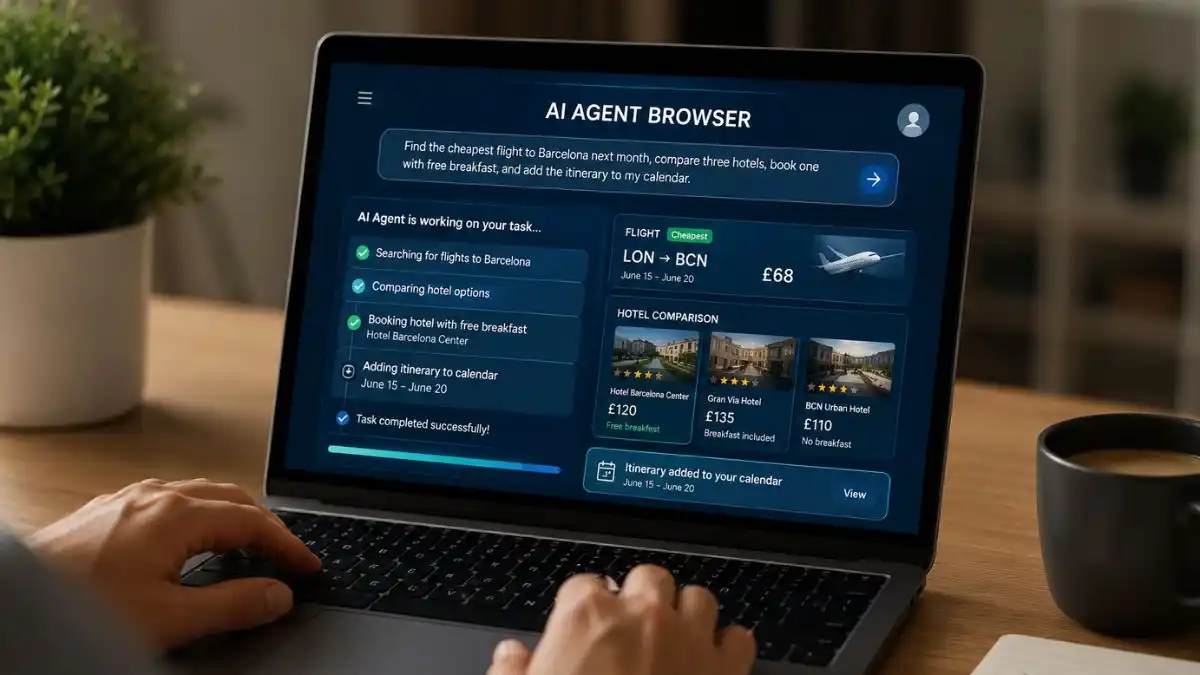
Imagine asking your computer:

“Find the cheapest flight to Barcelona next month, compare three hotels, book one with free breakfast, and add the itinerary to my calendar.”

Instead of giving you ten blue links and leaving you to do the work, an AI agent could handle those tasks itself.

That idea sits at the heart of something many people are suddenly talking about: agentic browsing.

Google, OpenAI, Microsoft and other technology companies are building systems that go beyond traditional search. Rather than simply finding information, these systems can understand requests, navigate websites, compare products and services, and even complete actions on behalf of users.

Google recently introduced an experimental Agentic Browsing category in Lighthouse, the technology behind PageSpeed Insights. At the same time, announcements around Gemini and AI-powered assistants have raised a much bigger question:

Are we entering a future where AI becomes the visitor, not just the person sitting behind the screen?

The answer is more complicated than many headlines suggest.

Question Simple Answer
What is an agentic browser? A browser that can perform tasks, not just display websites
Is Google getting rid of Search? No
Will AI agents browse websites? Yes
Will websites still matter? Absolutely
Is SEO dead? No, but it’s evolving
Does PageSpeed still matter? More than ever
Can AI buy products? Increasingly yes
Should businesses prepare now? Yes

What Is an Agentic Browser?

For more than thirty years, web browsers have worked in roughly the same way.

  1. You typed something.
  2. The browser showed information.
  3. You clicked links.
  4. You read pages.
  5. You filled forms.
  6. You made decisions.
  7. Humans did all the work.
  8. Agentic browsers change that relationship.

Instead of acting as passive windows into the web, they become active assistants capable of completing tasks.

Think of them as digital helpers that can understand instructions and carry out multiple steps automatically.

For example, you could say:

  • “Find me a dentist open on Saturday.”
  • “Compare insurance prices.”
  • “Book a table for four.”
  • “Buy the cheapest Samsung Galaxy available with next-day delivery.”

The AI agent doesn’t simply show pages.

It navigates websites, compares information and may eventually complete transactions.

That is why many experts believe agentic browsing represents one of the biggest changes since the arrival of smartphones.

Why Everyone Suddenly Started Talking About Agentic Browsers

Until recently, very few people outside Silicon Valley used the phrase.

That changed after several developments came together:

  • Google’s Gemini expansion.
  • AI Overviews.
  • AI Mode.
  • Google I/O announcements.
  • OpenAI’s operator systems.
  • Anthropic’s computer-use models.
  • Microsoft’s Copilot ambitions.
  • Perplexity’s AI browser experiments.
  • Google’s new Agentic Browsing category inside Lighthouse.

Together, these developments suggest something important. The internet is moving beyond simple search. AI systems are learning how to act. And websites are beginning to be designed not just for humans, but for machines that act like humans.

Is Google Getting Rid Of Search?

One of the biggest fears people have is that traditional Google Search is disappearing.

The answer is no.

Search itself isn’t going away.

But it is changing.

For more than twenty years, search meant:

  1. Ask a question.
  2. Receive links.
  3. Click websites.
  4. Find answers.

Now Google increasingly provides:

  • AI Overviews.
  • AI Mode.
  • Gemini assistance.
  • Personalized recommendations.
  • Multi-step tasks.

Traditional search results still exist.

But Google wants users to spend less time searching and more time getting things done.

Search is evolving from an index of pages into an assistant.

That’s a major difference.

Is Google Going Full AI?

Some people believe Google is abandoning search entirely.

That’s unlikely.

Instead, AI is becoming part of almost everything Google does.

Today AI touches:

Search

AI Overviews and AI Mode.

Gmail

Smart replies and summaries.

Maps

Personal recommendations.

Photos

Object recognition and editing.

Android

Assistant capabilities.

Chrome

AI assistance inside the browser.

Workspace

Writing and productivity tools.

Gemini

Advanced reasoning and task completion.

Google isn’t replacing search.

It’s adding intelligence everywhere.

What Happened At Google I/O 2026?

Google I/O 2026 showed one clear direction.

Google wants AI to become proactive.

Instead of waiting for users to perform every step manually, AI systems increasingly help people:

  • Research.
  • Compare.
  • Organize.
  • Book.
  • Shop.
  • Write.
  • Navigate.

This is where Gemini Spark and agentic experiences become important.

The goal isn’t simply answering questions.

It’s helping users complete tasks.

What Is Gemini Spark AI?

One of the names that began attracting attention after Google I/O 2026 was Gemini Spark.

Many people immediately wondered whether this was another chatbot competing with ChatGPT.

The reality is more interesting.

Google’s long-term vision is not simply about answering questions. It is about creating AI assistants that can help people accomplish tasks.

Traditional search works like this:

  1. You ask a question.
  2. Google shows results.
  3. You visit websites.
  4. You compare options.
  5. You make decisions.

Agentic AI aims to reduce those steps.

Instead of showing ten websites and asking you to do everything manually, AI systems can potentially perform some of those tasks for you.

Imagine asking:

“Find the best hotel in Rome for under £200 a night, with breakfast included, and close to the Colosseum.”

Instead of opening dozens of tabs, the AI could:

  • Search websites.
  • Compare prices.
  • Filter reviews.
  • Check availability.
  • Present the best options.

This is the difference between traditional search and agentic assistance.

The internet becomes less about browsing and more about accomplishing goals.

How Agentic Browsers Work

Agentic Browsing Explained The Future of AI Search

At first glance, agentic browsing sounds almost magical.

In reality, it follows a process.

Step 1: Understanding Your Goal

The AI interprets your request.

Instead of focusing on keywords, it focuses on intent.

For example:

“Book a family holiday in Spain.”

The AI understands that several steps are involved.

Step 2: Research

The agent visits websites.

It gathers information from:

  • Travel sites.
  • Hotel pages.
  • Airline websites.
  • Review platforms.

Step 3: Comparison

The system compares:

  • Prices.
  • Locations.
  • Ratings.
  • Availability.

Step 4: Recommendations

Instead of giving 100 results, it narrows everything down.

Step 5: Action

Future AI systems may:

  • Fill forms.
  • Make bookings.
  • Complete purchases.
  • Schedule appointments.

Humans remain in control, but much of the repetitive work disappears.

Normal Browsers Versus Agentic Browsers

Traditional Browser Agentic Browser
Shows websites Completes tasks
User does everything AI assists
Requires many clicks Fewer steps
Passive tool Active assistant
Search-based Goal-based
User compares options AI compares options
User fills forms AI may fill forms

This represents one of the biggest shifts in internet history.

Can AI Buy Things For You?

Increasingly, yes.

Imagine saying:

“I need new running shoes under £100.”

An AI assistant might:

  • Visit stores.
  • Compare prices.
  • Read reviews.
  • Find discounts.
  • Recommend the best choice.

In the future, AI could even complete purchases after receiving approval.

This changes e-commerce completely.

Companies are already developing systems capable of:

  • Booking flights.
  • Ordering groceries.
  • Reserving hotels.
  • Scheduling appointments.
  • Comparing insurance quotes.

The age of AI shopping assistants is beginning.

How AI Agents Read Websites

Humans look at:

  • Colours.
  • Images.
  • Fonts.
  • Design.

AI agents see websites differently.

They depend on:

Structure

Clear headings.

Navigation

Menus that make sense.

Forms

Proper labels and buttons.

Content

Easy-to-understand language.

Schema

Structured data that explains meaning.

Accessibility

Information designed for everyone.

In many ways, AI systems behave like blind visitors.

They rely on the structure beneath the design.

Why Accessibility Suddenly Matters More

For years, accessibility was mainly discussed in terms of helping people with disabilities. That remains incredibly important. But accessibility is becoming important for another reason. AI systems depend heavily on accessibility trees.

When a website has:

  • Proper headings.
  • Clear forms.
  • Button labels.
  • Good navigation.

AI can understand it more easily.

Ironically, building websites for people with accessibility needs also makes them easier for AI systems to understand.

Good accessibility benefits everyone.

Will Websites Lose Traffic?

This question worries many business owners.

The answer is yes and no.

Some searches will produce fewer clicks.

For example:

“What is the capital of Italy?”

People may simply accept an AI answer.

But for important decisions, people still want websites.

Examples include:

  • Buying cars.
  • Choosing lawyers.
  • Finding local businesses.
  • Reading reviews.
  • Comparing products.

Trust still matters.

Humans often want to verify information themselves.

Websites are not disappearing.

Their role is changing.

Is SEO Dead?

No.

People have predicted the death of SEO for twenty years.

Mobile phones didn’t kill SEO.

Social media didn’t kill SEO.

Voice search didn’t kill SEO.

AI won’t kill SEO either.

But SEO is changing.

The future belongs to:

  • Helpful content.
  • Expertise.
  • Structured data.
  • Strong brands.
  • Trust.
  • User experience.

SEO becomes less about tricks and more about authority.

What Is Agentic SEO?

Traditional SEO focused on ranking pages.

Agentic SEO focuses on making websites understandable to AI systems.

This includes:

  • Semantic HTML.
  • Schema markup.
  • Accessibility.
  • Fast websites.
  • Clear navigation.
  • Structured information.

The goal remains the same.

Helping people.

But now machines also need to understand your content.

What Is llms.txt?

Think of llms.txt as robots.txt for AI.

Robots.txt tells search engines what they can access.

llms.txt may eventually help AI systems understand:

  • Which information matters.
  • What pages contain.
  • How content should be interpreted.

At the moment, standards are still evolving.

But many developers believe files like llms.txt could become increasingly important.

What Is WebMCP?

WebMCP is another concept appearing inside Google’s experimental Agentic Browsing category. In simple terms, it aims to make websites easier for AI agents to interact with. Think of it as creating clearer instructions for machines.

  • Humans use screens.
  • AI uses structure.
  • WebMCP helps bridge that gap.
  • Most website owners don’t need to worry about the technical details today.
  • But the direction is clear.
  • The web is becoming more machine-friendly.

What Is Google’s Agentic Browsing Report?

Google recently introduced an experimental Agentic Browsing section inside Lighthouse. The goal is not to produce another PageSpeed score. Instead, Google wants developers to think about whether websites are usable by AI agents.

The report looks at areas such as:

  • Accessibility.
  • Layout stability.
  • AI readability.
  • WebMCP support.
  • llms.txt recommendations.

Google has stressed that this category is experimental.

But history suggests Google often introduces ideas years before they become mainstream.

Which Industries Could Change Most?

Which Industries Could Change Most

Online Shopping

AI agents could compare thousands of products.

Travel

Booking flights and hotels becomes easier.

Insurance

Agents can compare policies instantly.

Restaurants

Table reservations become simpler.

Healthcare

Appointment systems may become automated.

Local Businesses

Finding services becomes faster.

News Websites

Publishers may receive traffic differently.

Real Estate

Property searches may become agent-driven.

How Businesses Should Prepare

The good news is that most businesses do not need to panic.

The fundamentals remain largely the same.

Focus on:

✓ Fast websites.

✓ Mobile experience.

✓ Clear content.

✓ Good accessibility.

✓ Structured data.

✓ Strong branding.

✓ Helpful information.

✓ Trust.

The businesses that win tomorrow are likely to be those that help both humans and AI understand what they offer.

The Future Of Search

Search is unlikely to disappear. Instead, it will evolve.

The journey may look like this:

  • 1998 : Search engines.
  • 2010: Mobile-first internet.
  • 2020: Voice assistants.
  • 2025: AI Overviews.
  • 2026: Agentic browsing.
  • 2030: AI assistants handling many tasks automatically.

Humans won’t stop using websites. But increasingly, AI will become part of the journey. The future internet will probably be shared between humans and intelligent agents.

How OpenAI, Google, Microsoft And Anthropic Are Building The Next Internet

How OpenAI, Google, Microsoft And Anthropic Are Building The Next Internet

Google isn’t alone.

One reason so many experts believe agentic browsing is real and not simply another buzzword is because almost every major AI company is moving in the same direction.

They’re all trying to solve the same problem.

How can AI move beyond answering questions and start helping people complete tasks?

OpenAI

ChatGPT started by answering questions.

But OpenAI quickly moved toward AI agents.

Operator, ChatGPT Tasks and other experimental features show the company wants AI to:

  • Search websites.
  • Compare information.
  • Perform tasks.
  • Assist with shopping.
  • Handle repetitive work.

Instead of acting like a search engine, ChatGPT increasingly behaves like a digital assistant.

Google

Google’s approach revolves around Gemini.

  • AI Overviews.
  • AI Mode.
  • Gemini inside Chrome.
  • Gemini across Android.
  • Gemini inside Workspace.
  • And now experimental Agentic Browsing inside Lighthouse.

Google’s goal isn’t to replace search overnight.

It wants to evolve search into something more useful.

Microsoft

Microsoft has integrated Copilot across:

Their vision is very similar.

AI becomes your assistant rather than simply another website.

Anthropic

Anthropic shocked many people with its computer-use demonstrations. Claude can understand screens and interact with interfaces much like a human. This showed that AI doesn’t necessarily need special websites. It can use websites similarly to the way humans do.

Perplexity

Perplexity is trying to merge search and AI into one experience. Instead of showing ten links, it delivers summarized answers while still citing sources. The entire industry is moving in one direction. The web is becoming action-oriented.

Could AI Agents Replace Humans Online?

Not really.

But they may replace repetitive tasks.

Nobody enjoys:

  • Comparing 25 insurance quotes.
  • Reading hundreds of reviews.
  • Filling endless forms.
  • Searching dozens of websites.

AI agents are likely to take over those activities.

Humans will still make important decisions.

Trust, emotions and judgment remain uniquely human.

AI helps.

Humans decide.

Will AI Kill Google Ads?

Probably not.

But advertising may evolve.

Today, ads compete for human attention.

Tomorrow, businesses may compete for AI recommendations.

Imagine asking:

“Find me the best family SUV under £40,000.”

An AI system might evaluate:

  • Reviews.
  • Prices.
  • Reliability.
  • Reputation.
  • Safety.

Advertising could shift from:

“Who shouts the loudest?”

To:

“Who genuinely provides the best answer?”

Trust and reputation may become even more valuable.

AI Shopping Could Change E-Commerce Forever

Shopping has always involved work.

  • Search.
  • Compare.
  • Read reviews.
  • Look for discounts.
  • Check delivery times.

AI can automate much of this process.

Imagine saying:

“I need a washing machine under £500 with excellent energy efficiency and next-day delivery.”

The AI may:

  • Search retailers.
  • Compare prices.
  • Read reviews.
  • Check availability.
  • Recommend products.

Eventually it could complete purchases after approval.

This could transform:

  • Amazon.
  • Grocery shopping.
  • Electronics.
  • Travel.
  • Fashion.
  • Insurance.

Businesses may need to optimize for AI recommendations as much as traditional search.

What Happens To Affiliate Websites?

Affiliate marketing won’t disappear.

But thin content sites could struggle.

Pages designed purely to rank and make commissions may find themselves competing against AI systems capable of summarizing information instantly.

Meanwhile, websites offering:

  • Expertise.
  • Testing.
  • Reviews.
  • Original opinions.
  • Videos.
  • Real experiences.

May become even more valuable.

Authenticity matters.

Will AI Destroy News Websites?

Publishers are understandably concerned.

AI systems can summarize information.

But journalism is more than summarizing.

Reporters:

  • Interview people.
  • Investigate.
  • Verify facts.
  • Explain events.
  • Add context.

Without publishers, AI has nothing new to learn from.

This means trusted news organizations remain essential.

Traffic patterns may change.

But journalism itself remains important.

Why Trust Will Become More Valuable

For years SEO focused heavily on keywords.

The next internet may focus more on trust.

AI systems increasingly evaluate:

  • Authority.
  • Reputation.
  • Expertise.
  • Reviews.
  • User experience.

Brands people recognize may gain advantages.

Small businesses can still compete.

But quality becomes increasingly important.

How To Prepare Your Website For AI Agents

Fortunately, the advice is surprisingly familiar.

Build Fast Websites

Nobody likes waiting.

Neither do machines.

Improve Accessibility

AI agents rely heavily on accessibility information.

Good accessibility helps everyone.

Use Proper Headings

Clear structure helps humans and AI.

Create Helpful Content

Answer questions simply.

Avoid jargon.

Focus on users.

Add Schema Markup

Structured data helps machines understand your content.

Make Forms Easy

Complicated forms confuse both humans and AI.

Improve Navigation

Simple menus work best.

Focus On Trust

Reviews.

Case studies.

Testimonials.

Author profiles.

Real expertise.

These signals matter.

Things Website Owners Should Stop Doing

The AI era rewards clarity.

Avoid:

Keyword stuffing

Write naturally.

Overdesigned websites

Fancy animations don’t impress AI.

Thin pages

Create useful content.

Hidden information

Make answers easy to find.

Poor accessibility

Accessible websites benefit everyone.

Slow loading pages

Speed still matters.

What Could Search Look Like In 2030?

Nobody knows exactly.

But one possible future might look like this.

Morning

Your AI assistant checks:

  • Emails.
  • Calendar.
  • Traffic.
  • Weather.

During The Day

It:

  • Books meetings.
  • Orders supplies.
  • Finds restaurants.
  • Organizes travel.

Shopping

AI compares:

  • Prices.
  • Reviews.
  • Delivery times.

And suggests options.

Search

Instead of typing ten separate questions, users simply explain goals.

The AI performs the work.

Humans remain in control.

But digital assistants become far more capable.

Why This Isn’t The End Of Websites

Every major change in technology brings predictions of extinction.

People said:

  • Television would kill radio.
  • The internet would kill newspapers.
  • Smartphones would kill computers.
  • Social media would kill websites.

Reality proved more complicated.

Technologies evolve.

They don’t simply disappear.

Websites remain the foundation of the internet.

AI agents still need information.

Businesses still need websites.

People still want brands they trust.

The web isn’t dying.

It’s changing.

Final Thoughts

Agentic browsing may sound futuristic, but many of the building blocks already exist.

Google.

OpenAI.

Microsoft.

Anthropic.

Perplexity.

All are moving toward AI systems capable of performing tasks, not just answering questions.

For business owners, the message is surprisingly reassuring.

The fundamentals haven’t changed.

Fast websites.

Helpful content.

Good accessibility.

Trust.

Clear navigation.

Strong brands.

These principles matter today.

And they’ll probably matter even more tomorrow.

The future internet won’t belong only to humans.

Nor will it belong only to machines.

It will belong to both.

And understanding that shift may become one of the most important digital skills of the next decade.

FAQ

What is an agentic browser?

An AI-powered browser capable of performing tasks rather than simply displaying websites.

Is Google replacing Search?

No. Search is evolving, not disappearing.

Is Google going full AI?

AI is becoming integrated across Google’s products, but traditional search still exists.

Can AI buy products?

Yes, AI agents are increasingly able to compare products and assist with purchases.

Will websites disappear?

No. Websites remain essential.

Is SEO dead?

No. SEO is changing, not dying.

What is Gemini Spark AI?

A new generation of AI assistance focused on completing tasks rather than only answering questions.

What is agentic SEO?

Optimizing websites so AI systems can understand and use them.

Does page speed still matter?

Absolutely. Fast websites improve both user experience and AI usability.

What is llms.txt?

A proposed file designed to help AI systems understand websites.

What is WebMCP?

A framework intended to make websites easier for AI agents to interact with.

Will AI replace Google?

No. AI is becoming part of Google rather than replacing it.

Will AI replace websites?

No. Websites remain the foundation of the internet.

Can AI book appointments?

Increasingly yes.

Will AI reduce website traffic?

Some searches may produce fewer clicks, but trusted websites remain important.

What industries will change most?

Shopping, travel, insurance, healthcare and local services.

How do I prepare my website?

Focus on speed, accessibility, structure and helpful content.

Should small businesses worry?

Not panic, but they should pay attention.

What happens to SEO in 2030?

SEO will likely focus more on authority and machine understanding.

Is agentic browsing the future?

Many experts believe it represents the next major evolution of the web.