
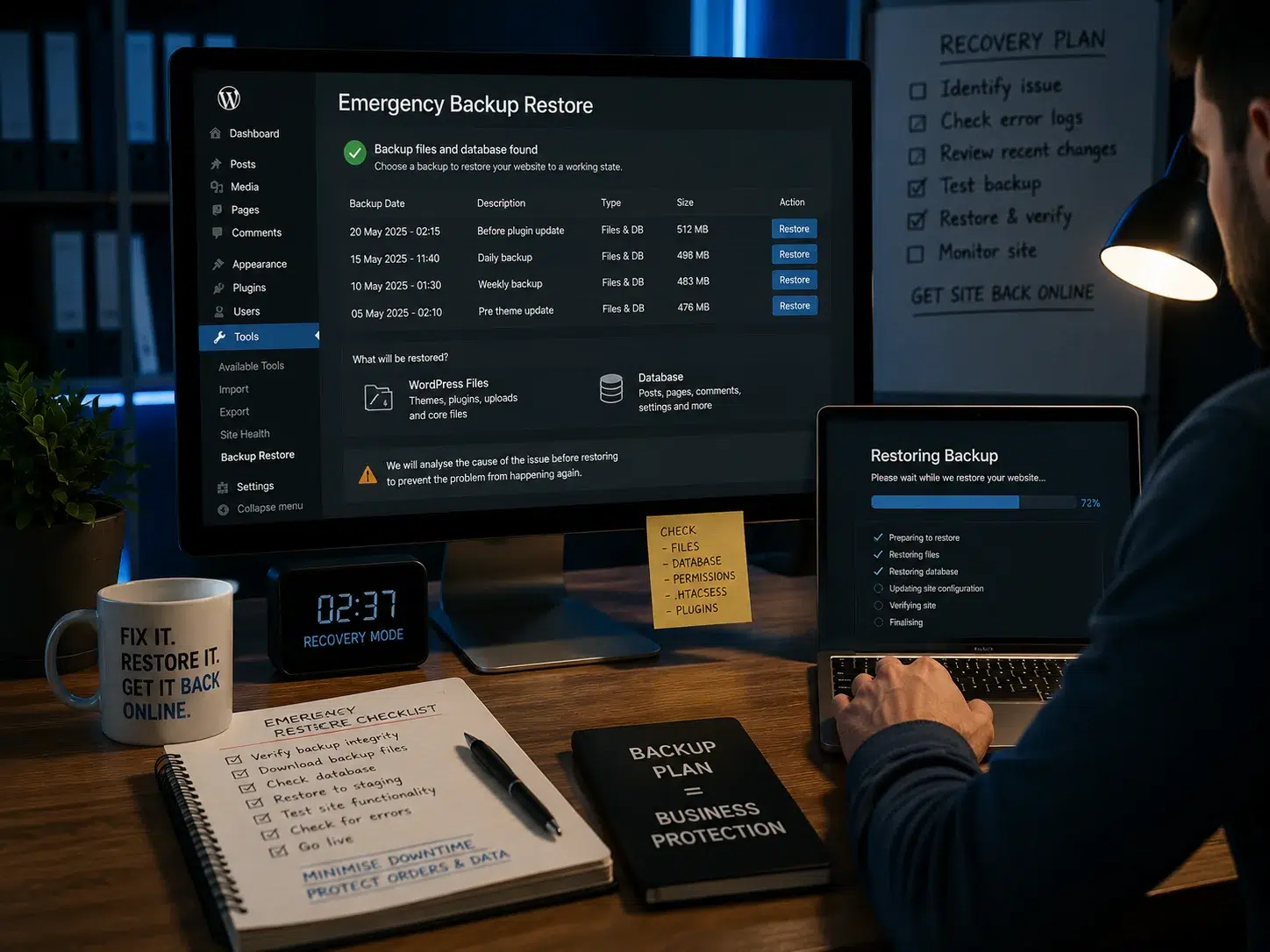

The right website backup frequency depends on how quickly your website changes and how much data you are prepared to lose if something goes wrong.
Back up according to the rate of change, not the size of the website.
A brochure site may be fine with daily or weekly backups. A WooCommerce, booking or membership site can need much more frequent database backups because orders, stock and customer data change throughout the day.
A simple backup schedule by website type
Daily or weekly can be enough if content rarely changes.
Daily backups plus form/submission protection.
More frequent database protection may be needed.
Frequent or real-time backups protect orders and stock.
Files and database change at different speeds
WordPress files include themes, plugins and uploads. The database contains posts, settings, users, orders and many forms of dynamic data. A shop may change its database every few minutes while its theme files stay unchanged for weeks.
Back up before risky changes
Regardless of your normal schedule, take or verify a current backup before major plugin updates, PHP changes, migrations, theme changes or large imports.
This is one reason a planned maintenance workflow matters. Our WordPress update guide explains how backups fit into safer updates.
Keep more than one restore point
If a compromise or silent fault began several days ago, yesterday’s backup may already contain the problem. Retention matters because you may need to go back further than the most recent copy.
Store backups away from the live site
A backup stored only on the same hosting account can disappear with the site if the account fails, is compromised or is deleted. Off-site or provider-independent copies improve resilience.
It protects the data you care about.
Files and database are covered.
Not only on the live server.
You know the recovery process works.
How many backups should you keep?
There is no universal number. A sensible retention policy normally includes recent daily restore points plus older weekly or monthly copies, adjusted to your business and storage limits.
What about WooCommerce?
WooCommerce stores orders, products, customers and settings in the database. Restoring a database from yesterday can remove today’s orders. That is why store backups need a tighter recovery point and a careful restore plan.
Should you test backups?
Yes. A backup that has never been test-restored is an assumption. Restore tests are best done in staging so you can confirm the files, database and key functions come back correctly.
Our upcoming guide on how to test a WordPress backup covers that process in detail.
If you had to restore a backup right now, how much recent data could the business afford to lose?
Backups as part of maintenance
Our website maintenance and support service includes backup and recovery planning appropriate to the site. Our maintenance cost guide explains why backup expectations differ by plan.
Backup frequency should follow how quickly the site changes
WordPress’s own administration guidance suggests weekly backups for smaller, low-activity sites and daily backups for high-activity sites. For a business, the better question is the recovery point objective: how much recent data could you afford to lose? A brochure site updated once a month can tolerate a different schedule from a store taking orders every few minutes.
Daily or weekly can be sensible depending on how often content changes.
Daily plus form/submission protection where enquiries are business-critical.
More frequent database protection may be needed to avoid losing recent orders or bookings.
A backup is not proven until a restore works
Keep multiple recent copies in more than one location and rehearse restoration to staging. A successful scheduled-backup notification proves a job ran; it does not prove the archive is complete, readable or usable under pressure.
See the official WordPress backup guidance for the underlying principles.
Backup frequency should follow recovery-point risk
People searching “how often should I back up my website?” usually want a schedule. The more useful answer is to work backwards from how much data the business can afford to lose.
Low-change brochure site
Weekly can be sufficient when content changes rarely, though daily automated backups are increasingly common and inexpensive.
Lead-generation website
Daily website backups make sense, but form entries may need their own storage or CRM protection so a restore does not erase recent enquiries.
Bookings, memberships and busy editorial sites
Several backups per day may be justified when bookings, users or content change continuously.
WooCommerce
Orders, stock and customer records can change minute by minute. High-volume stores may need hourly or real-time database protection rather than one overnight snapshot.
The 3-2-1 principle and retention
A resilient setup keeps multiple copies, across more than one storage location, with at least one copy away from the live hosting environment. Retention matters too: if malware or a silent fault began last week, yesterday’s backup may already contain the problem.
Competitor gap: frequency is useless without restore testing
A backup schedule only answers how often copies are created. It does not prove they are complete or restorable. That is why this article links into our separate restore-testing guide rather than duplicating the same intent.
FAQ
Is one daily backup enough?
It may be for a low-change brochure site. For ecommerce or bookings, one daily copy can leave a large recovery gap.
Should I keep backups on the same server?
Not as the only copy. Separate storage protects you from hosting-level failure or compromise.
Do backups include emails?
Website backups normally cover WordPress files and database, not necessarily your separate business email system.