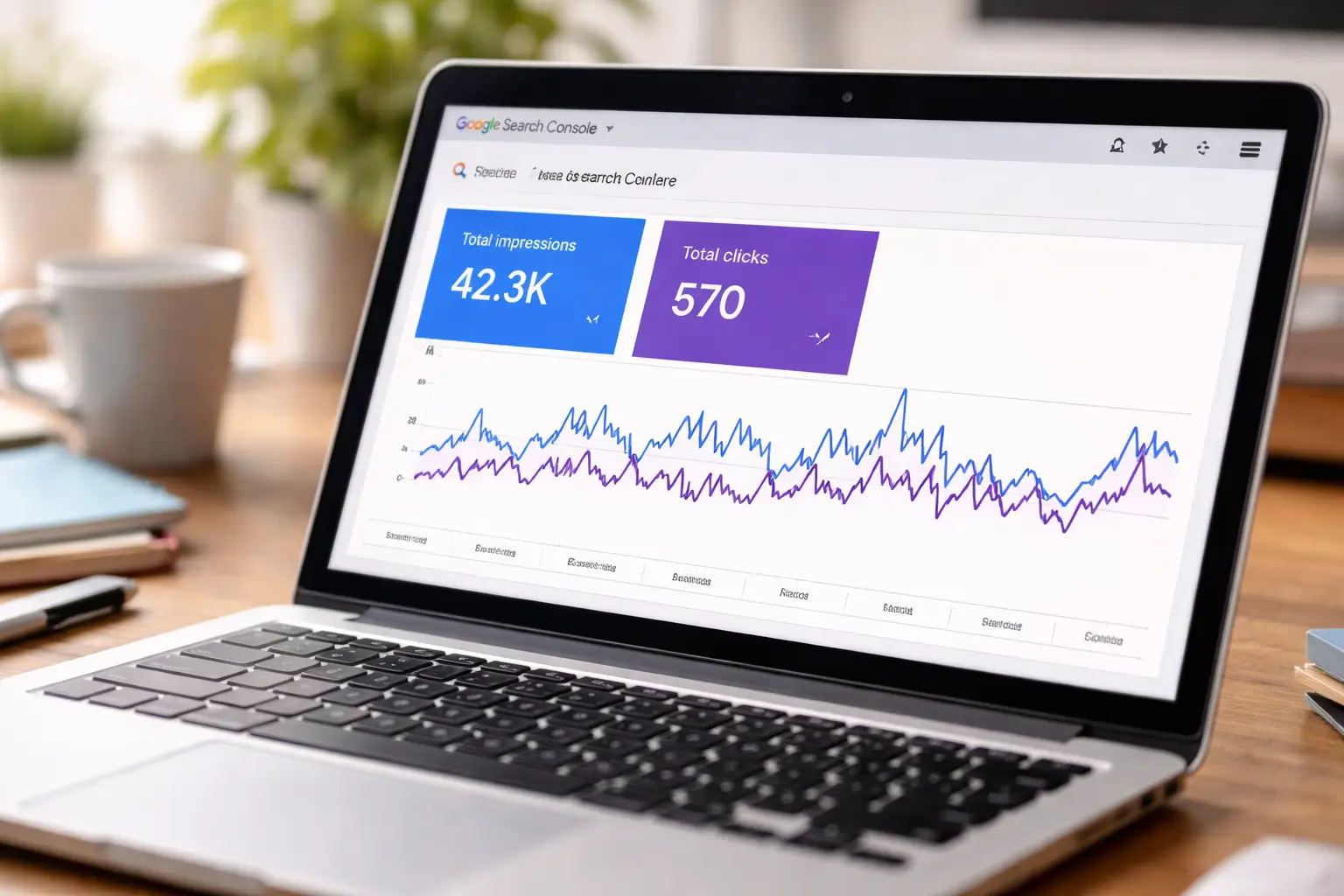
If you use Google Search Console and its indexing reports, rising impressions without more clicks can be confusing.
When an agency sends performance figures every month, its monthly SEO report should distinguish impressions, clicks and actual customer enquiries, rather than treating visibility alone as a business result.
Impressions are going up
Clicks are not
Traffic feels stuck
It is common, but the cause needs checking.
This guide explains exactly what impressions and clicks mean, why they don’t always match, and what to do when Google shows your pages but nobody clicks.
Impressions vs clicks: the basic difference
An impression records an appearance under Google’s reporting rules. A click records someone following a qualifying link from Google to your website. Neither metric by itself proves trust, a sale or a future ranking increase.
How to calculate CTR
CTR = clicks ÷ impressions × 100. For example, 12 clicks from 600 impressions gives 2% CTR. If there are no impressions, CTR cannot be calculated. Add the clicks and impressions first when combining rows; do not average the row percentages.
What is an impression in Google Search Console?
An impression means a link to your site was seen, or could have been seen, under the rules for that search result type. For a standard web result, it can count when the link is on the current results page even if the person does not scroll down to it.
A result on page three does not count merely because page three exists. The person must reach that set of results. Image results, carousels and expandable features have different visibility rules. An impression is not a visit, a unique person or proof that Google is running a test on your page.
What is a click in Google Search Console?
For most result types, a click counts when a person follows a link from Google to a page outside Google. Clicking a control that only starts another Google search is different.
A click does not prove the person read the article, contacted the business or bought anything. Check website analytics and your enquiry records for those later actions. Search Console and analytics use different measurement rules, so their totals need not match.
Is an impression the same as a click?
No. An impression measures a search appearance; a click measures an action from the result. A page can appear many times and receive few clicks, especially when it ranks low or appears for a question already answered on the results page.
Judge the page against relevant queries, positions, countries and devices. There is no single good CTR for every website or search.
Why do I have high impressions but low clicks?
First establish which searches created the impressions. The same total can hide weak rankings, unrelated searches, a less useful result or a change in Google’s layout. The checks below help separate those causes.
1. Your page is ranking too low to be noticed
A result far down the page may receive little attention. That does not prove users distrust it. Review the average position for each relevant query, rather than treating the page’s overall average as a fixed rank.
If the important queries rank poorly, check whether the page answers the search, includes useful evidence and is linked from relevant pages. A title edit alone is unlikely to solve all of those issues.
2. Your title doesn’t match what people want
A person searching for a price comparison may skip a general definition. Someone looking for a repair service may skip a DIY guide. Search the exact query and compare the purpose of the first five organic results with your page.
If the intent matches and visibility is strong, compare the displayed title and snippet. Google can choose different wording from the title and description you supply. Protect titles already earning useful clicks, and record a baseline before testing a change.
3. Mobile results push you down the page
Ads, Maps, videos, featured snippets and AI Overviews can change how far someone scrolls before reaching an ordinary organic result. Desktop and mobile layouts can differ.
Check the live result on the relevant device. An AI Overview might satisfy part of the question, but its presence alone does not prove it caused your traffic change. Record any linked sources separately from the ordinary organic listings.
4. New visibility does not prove Google is testing your page
New impressions show that the page is appearing in the selected report. They do not reveal why Google selected it, what experiments may be running or whether its position will improve.
Compare equal periods and inspect the actual queries. A new broad query can increase impressions while reducing overall CTR, even when performance on your original searches stays the same. Do not diagnose a penalty or promise future growth from impressions alone.
5. People are comparison-shopping
Some people compare several providers or return later. Search Console does not identify those individual journeys, so low CTR is not proof of comparison-shopping.
For a service page, make pricing, scope and the next step easy to understand. For an article, answer the question clearly before offering help. Track genuine enquiries separately from search clicks.
Why do I see impressions but no views?
Search Console reports clicks, impressions, CTR and average position. A “view” in another tool may mean something else, such as a page view in analytics or a video view.
Do not combine organic search impressions with Google Ads data or Social media views. Check the tool, report, dates and filters first. Consent choices, tracking errors and measurement rules can also affect analytics totals.
If a report suddenly looks wrong, check the dates, filters and known data issues. A previous Search Console reporting bug is background reading, not proof of a current fault. Check Google’s current notices before blaming the reporting system.
Why am I not getting clicks on Google Ads?
Paid ads have their own reporting and auction. Check the search terms, targeting, ad wording, eligibility, positions and landing page within Google Ads. A low organic CTR does not diagnose an advertising problem.
Budget and bids can affect when and where an ad appears. They do not explain every low-click case. Keep the paid and organic investigations separate so changes address the right system.
How long does it take for clicks to follow impressions?
There is no fixed waiting period and no guarantee that clicks will follow. A new page may gain impressions for searches it will never answer well. Another may already answer the search but face stronger results or limited click demand.
Allow for recrawling and enough new data to compare similar periods. Record the edit date and changes in position, query mix and search layout. A low-volume page may need longer observation than a busy one; a chosen number of weeks is not a Google deadline.
What should you fix first if clicks are low?
- Select the exact page. Compare the latest complete 28 days with the previous 28. Check a longer period for context.
- Choose the market. For a UK service, review UK searches and compare mobile with desktop.
- Separate the queries. Keep brand-name searches apart from non-brand terms. Distinguish definitions, problem-solving, price comparisons and requests for a provider.
- Calculate CTR. Divide clicks by impressions. Small samples and hidden query rows limit what you can conclude.
- Check position and intent. Review the same query and landing page across both periods, then inspect the live organic results and search features.
- Make a focused change. Improve the missing answer, evidence or result wording that the findings support. Keep working titles and useful links.
- Review the outcome. Compare equivalent dates and queries after Google has recrawled. Record clicks, impressions, position and real enquiries.
The most important thing to remember
Low CTR is a symptom, not a diagnosis. Poor ranking, unrelated searches and a weak snippet require different work. More impressions can reflect wider query coverage without bringing more potential customers.
Search Console also limits some query data for privacy. The visible query rows may not add up to the chart total. Do not describe the visible rows as every search.
Final takeaway
A useful review connects the search query, the landing page and the actual results people see. It then tests an improvement supported by that evidence. Impressions alone do not tell you what Google thinks, and clicks alone do not show business results.
What should you do when impressions rise but clicks do not?
A worked example: why overall CTR can mislead
Suppose a page earns 10 clicks from 500 relevant impressions in one period: 2% CTR. In the next period, it earns the same 10 clicks from those searches plus 500 impressions for unrelated terms. Overall CTR falls to 1%, although the original searches did not lose clicks. These are illustrative figures, not a client result.
Check the matching query group before changing a working title. If useful queries also lose position, investigate the content and competition. If position holds but clicks fall, inspect intent and the live result.
If you want Core Web UK to review the problem, share the landing page, target area and relevant Search Console period. A useful review should explain whether the evidence points to ranking, query relevance or result presentation, and record what will be measured after any change.
Definitions checked against Google’s Search Console Help page “What are impressions, position, and clicks?” on 23 October 2026. Search layouts and reporting rules can change.
