Skip to content

Technical SEO Audit Checklist for Small Business Websites

Technical SEO Audit Checklist for Small Business Websites

Technical SEO is often the difference between a website that ranks consistently and one that struggles to appear in Google search results. Many small businesses invest in attractive websites and quality content but overlook the technical issues that prevent search engines from crawling, indexing and understanding their pages properly.

A technical SEO audit helps identify those hidden problems. It looks beyond keywords and content to examine how your website performs behind the scenes. From page speed and mobile usability to broken links and structured data, every element contributes to your website’s ability to compete in search results.

Whether you manage your own website or work with a web design agency, performing regular technical SEO audits can improve rankings, create a better user experience and reduce the risk of losing valuable traffic because of preventable technical issues.

What Is a Technical SEO Audit?

A technical SEO audit is a detailed review of the technical elements that affect how search engines crawl, understand and index a website.

Unlike content SEO, which focuses on keywords and written content, technical SEO examines the infrastructure of your website. It identifies issues that may prevent search engines from accessing pages or that negatively affect user experience.

A complete technical SEO audit typically reviews:

  • Website crawlability
  • Indexing status
  • Website speed
  • Core Web Vitals
  • Mobile usability
  • HTTPS security
  • XML sitemaps
  • Robots.txt configuration
  • Internal linking
  • Structured data
  • Duplicate content
  • Canonical tags
  • Redirects
  • Broken links
  • Image optimisation

The goal is simple: make it as easy as possible for both search engines and visitors to use your website.

Why Technical SEO Matters for Small Businesses

Why Technical SEO Matters for Small Businesses

Large companies often have dedicated development teams monitoring website performance every day. Most small businesses do not.

Instead, websites gradually develop problems over time. Pages get deleted without redirects. Images become larger. Plugins conflict with one another. Website updates introduce unexpected errors.

These issues may seem minor individually, but together they can significantly reduce search visibility.

A technical audit helps identify problems before they begin affecting rankings, enquiries and sales.

Regular audits can also:

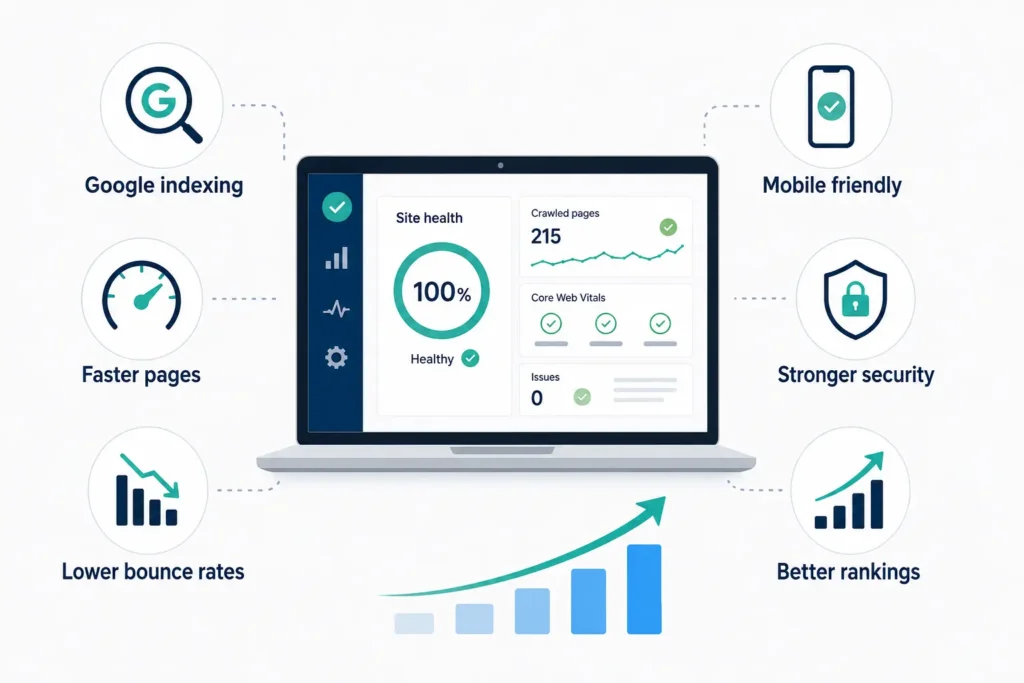
  • Improve Google indexing
  • Increase website speed
  • Reduce bounce rates
  • Improve mobile usability
  • Build trust through better security
  • Create a smoother customer experience
  • Support higher search rankings over time

For businesses competing locally, fixing technical SEO issues can provide an advantage over competitors whose websites have been neglected.

At a Glance

Before diving into the full audit, here’s a quick overview of the key areas every small business website should review.

Area Why It Matters
Website speed Faster websites improve rankings and user experience
Mobile usability Most searches now happen on mobile devices
HTTPS security Builds trust and protects customer data
Crawlability Helps search engines discover pages
XML sitemap Guides search engines to important content
Robots.txt Controls crawler access correctly
Internal linking Improves navigation and SEO authority
Structured data Helps search engines understand content
Broken links Prevents poor user experiences
Redirects Preserves SEO value when pages change
Duplicate content Prevents search engine confusion
Image optimisation Improves loading speed

Why Crawlability Comes First

Search engines cannot rank pages they cannot crawl.

Crawlability refers to Google’s ability to access every important page on your website.

Common crawl problems include:

  • Blocked pages in robots.txt
  • Broken internal links
  • Infinite URL parameters
  • Incorrect noindex tags
  • Server errors
  • Missing XML sitemaps

Even a well-designed website can lose visibility if Google cannot access its content efficiently.

One of the first steps in any technical SEO audit is confirming that search engines can crawl every important page without unnecessary obstacles.

Check Your XML Sitemap

An XML sitemap acts as a roadmap for search engines. It lists the important pages on your website and helps Google discover new or updated content more efficiently.

While Google can often find pages through internal links, a well-maintained sitemap improves the crawling process, particularly for larger websites or those with frequently updated content.

A good XML sitemap should:

  • Include only indexable pages
  • Exclude duplicate or redirected URLs
  • Update automatically when new pages are published
  • Be submitted through Google Search Console
  • Return a 200 status code without errors

Many websites continue to list pages that have been deleted or redirected. This can waste Google’s crawl resources and make it harder for search engines to identify the pages that actually matter.

For WordPress websites, SEO plugins usually generate XML sitemaps automatically, but they should still be reviewed regularly to ensure they remain accurate.

Review Your Robots.txt File

The robots.txt file tells search engine crawlers which parts of your website they can or cannot access.

Used correctly, it helps search engines focus on valuable content. Used incorrectly, it can accidentally block entire sections of your website from appearing in search results.

Common mistakes include:

  • Blocking important pages
  • Blocking CSS or JavaScript files
  • Preventing Google from accessing images
  • Using outdated directives after a website redesign

A simple robots.txt file is usually the best approach. Unless there is a specific reason to restrict access, avoid overcomplicating it.

Every technical SEO audit should confirm that important pages remain crawlable and that no valuable content has been unintentionally blocked.

Check Indexing Status

Not every page on your website should appear in Google, but every important page should.

One of the quickest ways to assess indexing is by comparing the number of indexed pages with the number of pages that should be visible in search.

Pages commonly excluded from indexing include:

  • Login pages
  • Shopping cart pages
  • Thank you pages
  • Duplicate content
  • Filtered search pages

Problems arise when service pages, blog posts or product pages are missing from Google’s index.

Common reasons include:

  • Noindex tags
  • Canonical errors
  • Crawl issues
  • Thin content
  • Duplicate pages
  • Server problems

Google Search Console provides valuable insights into indexing issues and highlights pages that have been discovered but not indexed.

Finding these problems early can prevent valuable content from remaining invisible in search results.

Test Website Speed

Website speed is one of the most important technical SEO factors.

Users expect websites to load almost instantly. Even small delays can increase bounce rates and reduce conversions.

Google also considers page speed as part of its ranking systems, particularly through Core Web Vitals.

A technical audit should examine:

  • Large image files
  • Slow hosting
  • Excessive JavaScript
  • Render-blocking CSS
  • Poor caching
  • Unused code
  • Third-party scripts

Improving speed often provides benefits beyond SEO.

Faster websites typically generate:

  • Longer visit durations
  • Lower bounce rates
  • Higher conversion rates
  • Better customer satisfaction

Even reducing page load time by one second can make a noticeable difference for small businesses competing in local search.

Measure Core Web Vitals

Core Web Vitals are Google’s performance metrics that evaluate how users experience your website.

They focus on three key measurements.

Largest Contentful Paint (LCP)

Measures how quickly the main content loads.

A good score is under 2.5 seconds.

Interaction to Next Paint (INP)

Measures how responsive your website is when users click buttons, menus or forms.

A lower response time creates a smoother browsing experience.

Cumulative Layout Shift (CLS)

Measures unexpected movement on the page while it loads.

Examples include:

  • Buttons moving before they are clicked
  • Images loading without reserved space
  • Text shifting as adverts appear

Google recommends a CLS score below 0.1.

Improving these three metrics not only supports SEO but also creates a faster, more professional website that visitors are more likely to trust.

Make Sure Your Website Is Mobile-Friendly

Google now primarily evaluates websites using their mobile version rather than the desktop version.

If your website performs poorly on smartphones, rankings can suffer even if the desktop experience is excellent.

During a technical SEO audit, check:

  • Responsive layouts
  • Font sizes
  • Button spacing
  • Navigation menus
  • Form usability
  • Image scaling
  • Loading speed on mobile networks

Remember that many local customers will discover your business while browsing on their phones.

A mobile-friendly website isn’t just an SEO requirement—it directly affects enquiries, bookings and online sales.
Verify HTTPS Security

Verify HTTPS Security

Website security is an essential part of technical SEO.

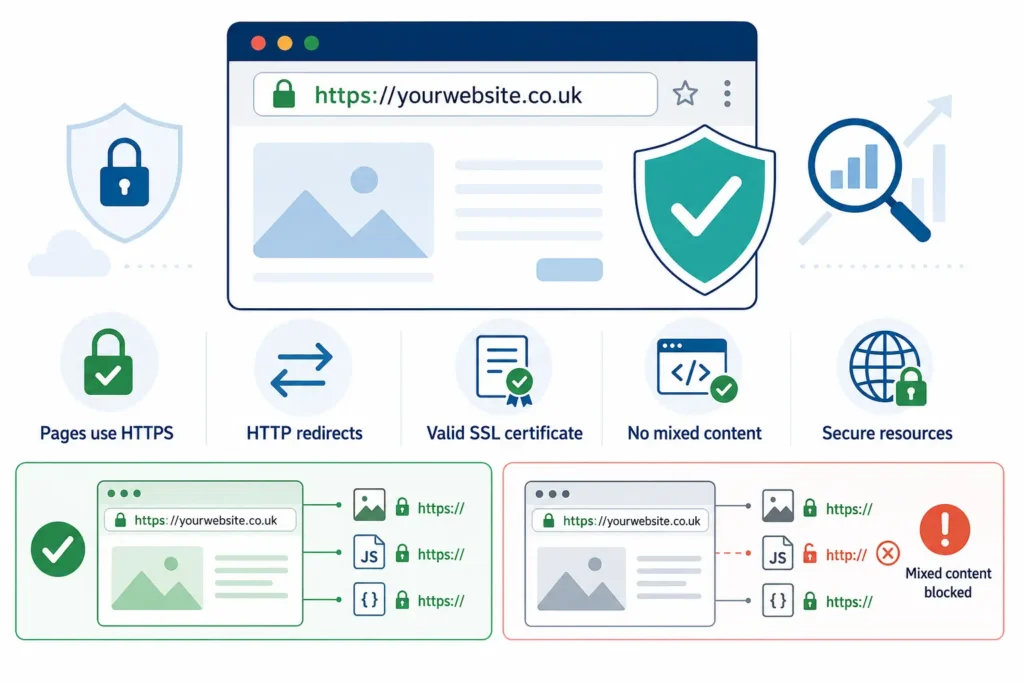
Visitors expect every website to use a secure HTTPS connection, and Google has treated HTTPS as a ranking signal for several years. Browsers also warn users when a site is not secure, which can reduce trust before they even view your content.

During your audit, check that:

  • Every page loads over HTTPS
  • HTTP versions redirect to HTTPS
  • Your SSL certificate is valid and up to date
  • No mixed content warnings appear
  • Images, scripts and stylesheets all load securely

Mixed content occurs when a secure page loads resources over HTTP. Even if the website appears to work normally, browsers may block those resources, leading to layout issues and security warnings.

A secure website protects customer information while improving credibility with both users and search engines.

Find Broken Links

Broken links create frustration for visitors and make it harder for search engines to crawl your website effectively.

Internal broken links are especially harmful because they interrupt the journey between pages and can reduce the flow of SEO value throughout your site.

Look for:

  • 404 errors
  • Links pointing to deleted pages
  • Incorrect URLs
  • Broken image links
  • Broken PDF downloads

External links should also be reviewed periodically. If a trusted source changes or removes a page, updating the link helps maintain a better user experience.

Fixing broken links is often one of the quickest improvements you can make during a technical SEO audit.

Review Redirects

Redirects are necessary whenever a page moves to a new location, but they should be implemented carefully.

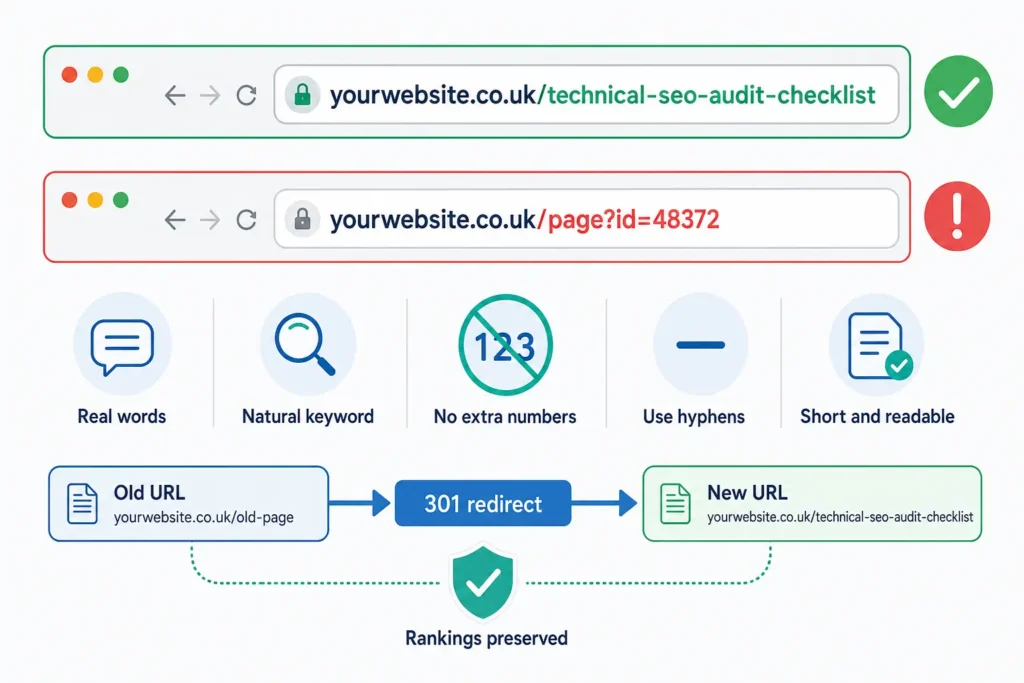
A proper 301 redirect transfers users and search engines from the old URL to the new one while preserving most of the page’s SEO value.

Problems occur when websites contain:

  • Redirect chains
  • Redirect loops
  • Temporary (302) redirects used permanently
  • Redirects pointing to irrelevant pages

For example, if a service page has been renamed, redirect the old URL directly to the new version rather than sending visitors through multiple redirects.

Keeping your redirect structure clean improves crawl efficiency and page loading speed.

Check URL Structure

Check URL Structure

URLs should be simple, descriptive and easy to understand.

A clear URL helps both users and search engines identify the topic of a page before it is opened.

Good URLs typically:

  • Use real words
  • Include the primary keyword naturally
  • Avoid unnecessary numbers
  • Use hyphens instead of underscores
  • Remain short and readable

For example:

Good

yourwebsite.co.uk/technical-seo-audit-checklist

Less helpful

yourwebsite.co.uk/page?id=48372

Changing established URLs should always be handled carefully. If a URL must change, implement a permanent redirect to preserve rankings.

Identify Duplicate Content

Duplicate content doesn’t usually result in a Google penalty, but it can confuse search engines about which version of a page should appear in search results.

Common causes include:

  • Multiple versions of the homepage
  • Product variations
  • Printer-friendly pages
  • URL parameters
  • Copied service pages
  • Similar location pages with minimal differences

A technical audit should identify duplicate pages and determine whether they should:

  • Be merged
  • Redirected
  • Canonicalised
  • Rewritten

Unique, high-quality content gives search engines a clearer understanding of your website and improves the chances of each page ranking for relevant searches.

Use Canonical Tags Correctly

Canonical tags tell search engines which version of a page should be treated as the original.

They are particularly useful for websites that generate multiple URLs for similar content, such as e-commerce stores with filtering or sorting options.

Incorrect canonical tags can cause search engines to ignore important pages.

Check that:

  • Each page points to the correct canonical URL
  • Self-referencing canonicals are used where appropriate
  • Canonicals do not point to redirected pages
  • Canonical tags are consistent across the website

Reviewing canonical tags helps prevent indexing issues and ensures search engines understand which pages deserve ranking priority.

Audit Internal Linking

Internal links help visitors navigate your website while showing search engines how your pages relate to one another.

A strong internal linking structure distributes authority across your site and helps Google discover new or updated content more efficiently.

When reviewing your internal links, look for:

  • Important pages with very few internal links
  • Orphan pages that are not linked from anywhere else
  • Broken internal links
  • Overuse of generic anchor text such as “Click here”
  • Opportunities to link related content naturally

For example, if you publish a guide about website speed, it should link to related articles on Core Web Vitals, image optimisation and website maintenance. Likewise, those articles should link back where relevant.

A well-planned internal linking strategy benefits both SEO and the overall user experience.

Review Meta Titles and Meta Descriptions

Meta titles and descriptions may seem like content elements, but they are also part of a technical SEO audit because they influence how your pages appear in search results.

Each page should have:

  • A unique title
  • A unique meta description
  • A clear focus keyword
  • A natural call to action where appropriate

Avoid:

  • Duplicate titles
  • Missing descriptions
  • Keyword stuffing
  • Titles that are too long and get truncated

A well-written title and description won’t guarantee higher rankings, but they can improve click-through rates by encouraging more people to visit your website.

Optimise Image SEO

Images often account for the largest portion of a webpage’s size, making them a common cause of slow loading times.

A technical SEO audit should assess whether images are optimised for both speed and search visibility.

Review the following:

  • File size
  • Image dimensions
  • Modern formats such as WebP or AVIF where supported
  • Descriptive file names
  • ALT text
  • Lazy loading
  • Compression without noticeable quality loss

For example, instead of uploading an image named:

IMG_4582.jpg

rename it to:

technical-seo-audit-checklist.jpg

Similarly, ALT text should describe the image accurately rather than simply repeating keywords.

Well-optimised images improve accessibility, reduce page load times and can generate additional traffic through Google Images.

Validate Structured Data

Structured data, also known as schema markup, helps search engines understand the purpose and content of your webpages.

Although structured data is not a direct ranking factor, it can improve how your pages appear in search through rich results.

Depending on your business, useful schema types include:

  • Local Business
  • Organisation
  • Service
  • Product
  • Article
  • FAQ
  • Breadcrumb
  • Review (where appropriate)

A technical audit should confirm that schema:

  • Is valid
  • Matches visible page content
  • Contains no errors or warnings
  • Uses the correct schema type

Incorrect or outdated schema can prevent rich search features from appearing.

Review Index Coverage

Google Search Console provides valuable information about which pages are indexed, excluded or experiencing technical issues.

During your audit, review reports for:

  • Indexed pages
  • Excluded pages
  • Pages with crawl errors
  • Soft 404s
  • Duplicate pages
  • Discovered but not indexed URLs
  • Crawled but not indexed URLs

If valuable pages are missing from Google’s index, investigate the cause rather than assuming they will eventually appear.

Early identification of indexing problems helps prevent lost visibility and traffic.

Check for Server Errors

Technical issues at the server level can prevent both visitors and search engines from accessing your website.

Some errors occur only occasionally, making regular monitoring important.

Watch for:

  • 404 Not Found
  • 500 Internal Server Error
  • 502 Bad Gateway
  • 503 Service Unavailable
  • DNS errors
  • Timeout errors

Frequent server issues can reduce crawl efficiency and negatively affect user trust.

Reliable hosting, proactive maintenance and regular monitoring all contribute to a healthier website.

Review Website Accessibility

While accessibility is not exclusively an SEO factor, many accessibility improvements also enhance search performance and user experience.

A technical SEO audit should check whether your website is easy for everyone to use.

Consider:

  • Logical heading structure
  • Descriptive link text
  • Keyboard navigation
  • Colour contrast
  • Image ALT text
  • Form labels
  • Readable font sizes

An accessible website reaches a wider audience and often performs better in search because it follows many of the same best practices recommended by Google.

Audit Your Website Regularly

Technical SEO is not something you complete once and forget.

Every website changes over time. New pages are added, plugins are updated, products are removed and design changes are introduced. Each update has the potential to create technical issues that affect search performance.

For most small businesses, a full technical SEO audit every three to six months is a sensible approach. Websites that publish content frequently or add new products every week may benefit from monthly reviews.

Regular audits help identify small issues before they become larger problems that impact rankings, traffic or customer enquiries. By making technical SEO part of your ongoing website maintenance, you create a stronger foundation for long-term organic growth.

Free Tools for a Technical SEO Audit

You don’t need expensive software to identify many common technical SEO issues. Several free tools provide valuable insights into website health and can help small businesses monitor performance regularly.

Google Search Console

Google Search Console should be the first tool in every technical SEO audit.

It provides direct information from Google about how your website performs in search, including:

  • Index coverage
  • Crawl errors
  • Core Web Vitals
  • Mobile usability
  • XML sitemap status
  • Search performance
  • Security issues

Checking Search Console regularly helps identify technical problems before they begin affecting rankings.

Google PageSpeed Insights

PageSpeed Insights analyses how quickly your website loads on both desktop and mobile devices.

It reports on Google’s Core Web Vitals and offers recommendations for improving performance, including:

  • Image optimisation
  • JavaScript reduction
  • CSS optimisation
  • Caching improvements
  • Server response time

Rather than chasing a perfect score, focus on resolving the issues that have the greatest impact on user experience.

Google Analytics 4

Although Google Analytics is primarily used for measuring traffic, it can also reveal technical issues indirectly.

For example, you may notice:

  • Pages with unusually high bounce rates
  • Slow-loading landing pages
  • Sudden traffic drops
  • Pages with poor engagement

These patterns often point to technical problems that require further investigation.

Bing Webmaster Tools

Many businesses overlook Bing Webmaster Tools, but it offers useful diagnostic information alongside Google’s tools.

It includes:

  • Site scans
  • Crawl reports
  • SEO recommendations
  • Indexing data
  • Backlink information

Reviewing both Google and Bing data provides a broader picture of your website’s technical health.

Screaming Frog SEO Spider

The free version of Screaming Frog allows you to crawl up to 500 URLs.

It quickly identifies:

  • Broken links
  • Missing page titles
  • Duplicate meta descriptions
  • Redirect chains
  • Missing ALT text
  • Canonical issues
  • Response codes

For small business websites, the free version is often enough to perform a thorough technical review.

GTmetrix

GTmetrix focuses on website speed and performance.

It helps identify:

  • Large images
  • Slow-loading resources
  • Excessive JavaScript
  • Performance bottlenecks
  • Loading waterfalls

Its reports make it easier to understand why a page feels slow and where improvements can be made.

Technical SEO Audit Checklist

Use this checklist as a quick reference during your next website review.

Audit Item Check
Website uses HTTPS
SSL certificate is valid
XML sitemap is up to date
Sitemap submitted to Google Search Console
Robots.txt reviewed
Important pages are indexable
No unnecessary noindex tags
Website is mobile-friendly
Core Web Vitals meet Google’s recommendations
Images are compressed
Images include descriptive ALT text
No broken internal links
No redirect chains or loops
URLs are clean and descriptive
Canonical tags are correct
Structured data validates successfully
Duplicate content reviewed
Internal links connect related pages
Meta titles are unique
Meta descriptions are unique
404 pages monitored
Server errors resolved
Website speed tested regularly
Google Search Console monitored

Completing this checklist every few months helps maintain a technically healthy website and reduces the likelihood of SEO issues developing unnoticed.

Common Technical SEO Mistakes Small Businesses Make

Many technical SEO problems are avoidable. The most common issues usually result from neglect rather than complexity.

Typical mistakes include:

  • Launching a redesigned website without checking redirects
  • Uploading large, uncompressed images
  • Publishing duplicate service pages
  • Forgetting to update XML sitemaps
  • Ignoring Google Search Console warnings
  • Using outdated plugins or themes
  • Leaving broken links unfixed
  • Blocking important pages in robots.txt
  • Failing to optimise for mobile devices
  • Never reviewing Core Web Vitals

Addressing these issues early is usually far easier than repairing lost rankings later.

What Happens Next?

A technical SEO audit is not about chasing a perfect score. It is about identifying the issues that have the greatest impact on your website’s visibility, performance and user experience.

Once the audit is complete, prioritise fixes that affect crawlability, indexing, page speed and mobile usability before moving on to smaller optimisation tasks. Monitor the results through Google Search Console and Analytics, then repeat the process regularly as your website grows.

Technical SEO is an ongoing process rather than a one-time project. Businesses that review their websites consistently are better positioned to maintain strong search visibility, adapt to Google’s evolving requirements and provide a faster, more reliable experience for every visitor.

Conclusion

A well-designed website is only effective if search engines can find, understand and index it correctly. That’s why technical SEO should be a core part of every small business’s digital strategy.

Regular technical audits help uncover hidden issues that can quietly reduce rankings, traffic and conversions. From improving website speed and fixing broken links to validating structured data and monitoring Core Web Vitals, every improvement strengthens the foundation of your online presence.

At Core Web, we help businesses identify and resolve technical SEO issues before they affect search performance. Whether you’re launching a new website or improving an existing one, a thorough technical SEO audit provides the insights needed to build sustainable long-term growth through organic search.