


A series of updates from Google over the past month is reshaping how businesses approach visibility in AI-powered search results, reinforcing the company’s position that success in AI Overviews and AI Mode remains rooted in traditional search engine optimization rather than separate “AI optimization” tactics.
The shift became clearer following updates to Google’s Search Central documentation and the rollout of new reporting tools in Google Search Console, providing website owners with greater visibility into how their content appears in AI-generated search experiences.
Google Clarifies Its Position on GEO and AEO
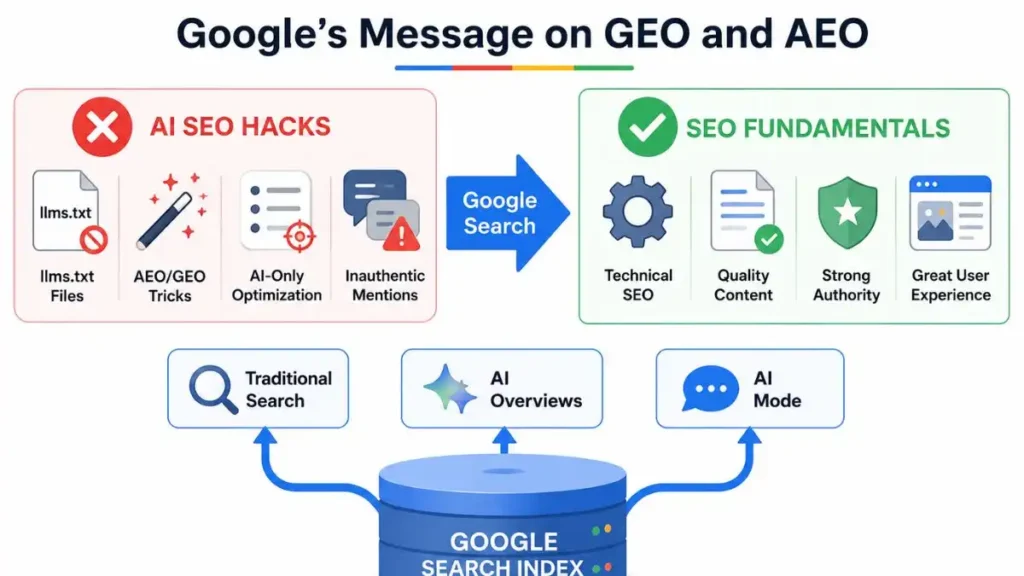
On 15 May 2026, Google updated its Search Central documentation with new guidance on optimizing websites for generative AI features in Search.
Within the new guidance, Google addressed industry terms such as Generative Engine Optimization (GEO) and Answer Engine Optimization (AEO), stating that many widely promoted tactics are not supported by how Google Search systems operate.
According to Google, website owners should focus on established SEO best practices rather than attempting to implement specialized GEO or AEO techniques.
The guidance is significant because it confirms that Google’s AI-generated search features do not rely on a separate index. Instead, AI Overviews and AI Mode draw information from the same search infrastructure used for traditional organic rankings.
What Powers Google’s AI Search Results?
Google’s AI search experiences use retrieval systems that identify relevant content from the existing search index before generating responses.
As a result, websites that struggle to achieve visibility in organic search are unlikely to gain meaningful exposure through AI-generated answers.
The company continues to emphasize technical accessibility, content quality, authority, relevance, and user experience as the primary factors supporting visibility across both traditional and AI-powered search experiences.
Google Rejects Several Popular AI SEO Claims
The updated documentation also addresses several tactics that have been widely marketed as methods for improving AI search visibility.
Google states that llms.txt files do not provide a special indexing pathway for AI systems and are treated similarly to other text documents discovered during crawling.
The company also notes that publishers do not need to restructure articles into artificial content fragments for AI consumption. Google’s systems are designed to understand complete pages and extract relevant information without manual content segmentation.
Similarly, Google indicates that rewriting content solely to target perceived AI-specific keyword patterns is unnecessary because its systems rely heavily on semantic understanding and user intent.
The documentation also warns against attempts to manipulate AI recommendations through artificial brand mentions or coordinated discussion campaigns, which remain subject to Google’s spam detection systems.
May Core Update Reinforces Quality Signals
The documentation changes were followed by two major developments in early June.
Google completed the rollout of its May 2026 Core Update on 2 June after nearly two weeks of search ranking volatility. Industry observers reported significant movement across a range of sectors as Google continued to prioritize original, experience-based content.
One day later, Google began rolling out AI performance reporting within Search Console, allowing website owners to track impressions and visibility across AI Overviews and AI Mode.
Together, these changes provide both policy guidance and measurement tools for businesses seeking to understand their performance in Google’s evolving search environment.
What This Means for Website Owners
The emerging message from Google is that AI visibility is becoming increasingly connected to the same signals that support strong organic rankings.
For publishers, businesses, and digital marketers, this places greater emphasis on producing original research, first-hand expertise, proprietary insights, and technically sound websites rather than investing in standalone AI optimization tactics.
The introduction of AI reporting in Search Console also gives organizations a direct way to evaluate which content is being surfaced in AI-generated experiences, helping inform future content and SEO strategies.
What Happens Next?
As AI search continues to evolve, Google appears to be moving toward greater transparency while maintaining a consistent position: websites do not need a separate optimization framework for AI search.
Instead, businesses that invest in strong technical SEO, high-quality content, and demonstrable expertise are likely to be best positioned for visibility across both traditional search results and AI-powered experiences.