
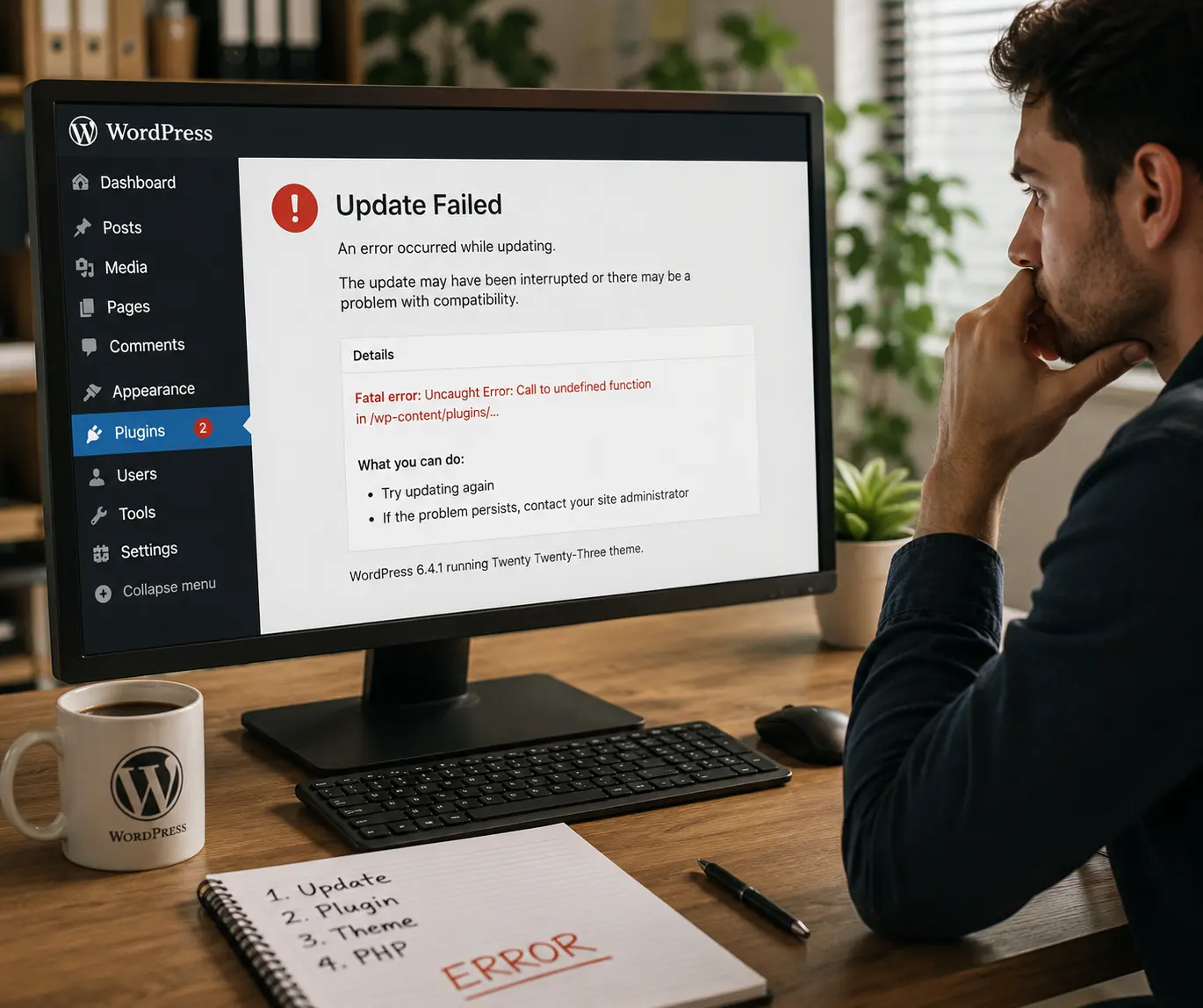

A WordPress update can finish without showing an obvious error and still leave part of the website broken. A page may lose its layout, a plugin can disappear, checkout fields can stop responding, or the whole site can show a fatal error.
The update is the trigger. The conflict is usually the cause.
Start with what changed, then isolate the failing layer. Do not immediately update everything else or restore a random backup.
Why a WordPress site can break after an update
WordPress websites are built from several moving parts: WordPress core, the active theme, plugins, PHP, server software and sometimes a page builder or ecommerce platform. An update changes one of those parts. If another part expects the old behaviour, the site can fail.
Two extensions no longer work together.
Templates or custom code rely on changed behaviour.
Old code fails on the current server runtime.
Old CSS, JS or object cache conflicts with new files.
First: identify exactly what broke
Do not treat every post-update problem as the same fault. Is the whole site down, only WordPress Admin affected, one Elementor page broken, checkout failing, forms not sending, or styling missing?
The narrower the symptom, the faster the diagnosis. Write down the update time and the versions that changed.
Clear caches before changing code
After an Elementor, theme or optimisation update, stale browser, page, object, CDN or server caches can make the site look broken even when the files are correct. Clear each cache layer once, then test in a private browser window.
Elementor’s own troubleshooting guidance recommends clearing browser, WordPress and server-side caches when unexplained issues appear after an update.
Check the error log and WordPress Recovery Mode
If the site shows a critical error, blank page or 500 response, read the PHP/server error log. It may identify the exact plugin or theme file that failed. WordPress Recovery Mode can also help administrators regain access after some fatal PHP errors.
Use conflict testing carefully
If you can reproduce the issue on staging, test the suspected plugin or theme there. Elementor recommends Safe Mode and controlled plugin testing for post-update problems. On a live ecommerce or booking site, disabling a stack of plugins can create more business disruption than the original problem.
Stop further updates.
Logs, symptoms, recent changes.
Plugin, theme, cache or server.
Roll back or patch deliberately.
When should you roll back?
A rollback can be appropriate when one specific update clearly caused the fault and a known-good previous version is available. But a rollback is not a permanent strategy. If the previous version contains a security issue or is incompatible with future updates, the underlying problem still needs a proper fix.
When should you restore a backup?
Restore only when you understand the data impact. A brochure site is relatively straightforward. A WooCommerce store may have received orders since the backup was created. Restoring its database can erase legitimate customer activity.
What to test before declaring the site fixed
- Homepage and key landing pages on mobile and desktop
- Navigation, buttons and click-to-call links
- Contact forms and confirmation emails
- Login and account areas
- WooCommerce basket, checkout and payment flow
- Booking or membership functions
- Admin editing and publishing
A successful update message in WordPress does not prove the customer journey still works.
Our WordPress update guide explains when to update and what to test. For ongoing staged updates, backups and post-update checks, see website maintenance and support.
Need the site back now?
If an update has already taken your website offline or broken a business-critical function, use our emergency website fixes service. We focus on the failing layer first rather than making unrelated changes across the site.
FAQ
Should I update the remaining plugins to fix the conflict?
Not blindly. More updates introduce more variables. Identify the failing combination first.
Can clearing cache fix a broken WordPress update?
It can fix stale CSS, JavaScript or page-cache symptoms, but it will not repair a genuine PHP or compatibility error.
Is it safe to roll back a plugin?
It can be a short-term recovery step when the cause is known, but check security implications and test the site afterwards.