

Running a small business in the UK has never been more competitive.
Whether you own a local plumbing company in Manchester, an independent retailer in London, a law firm in Birmingham or an ecommerce store serving customers nationwide, one thing is increasingly clear: if customers cannot find you online, they may never find you at all.
The way people search has also changed dramatically. Google now displays AI-generated answers, local map results and featured snippets before traditional website listings. Many searches end without a single click, while customers expect immediate answers and trustworthy businesses.
For UK small businesses, this might sound worrying. In reality, it creates a significant opportunity.
Large companies may have bigger marketing budgets, but small businesses often have something search engines value highly: local expertise, specialised knowledge and strong customer relationships.
Businesses that invest in SEO today are putting themselves in a stronger position to attract new customers, reduce reliance on paid advertising and build long-term growth.
This guide explains how SEO for small business UK works in 2026, why it matters and the practical steps you can take to improve your online visibility.
What Is SEO for Small Business UK?
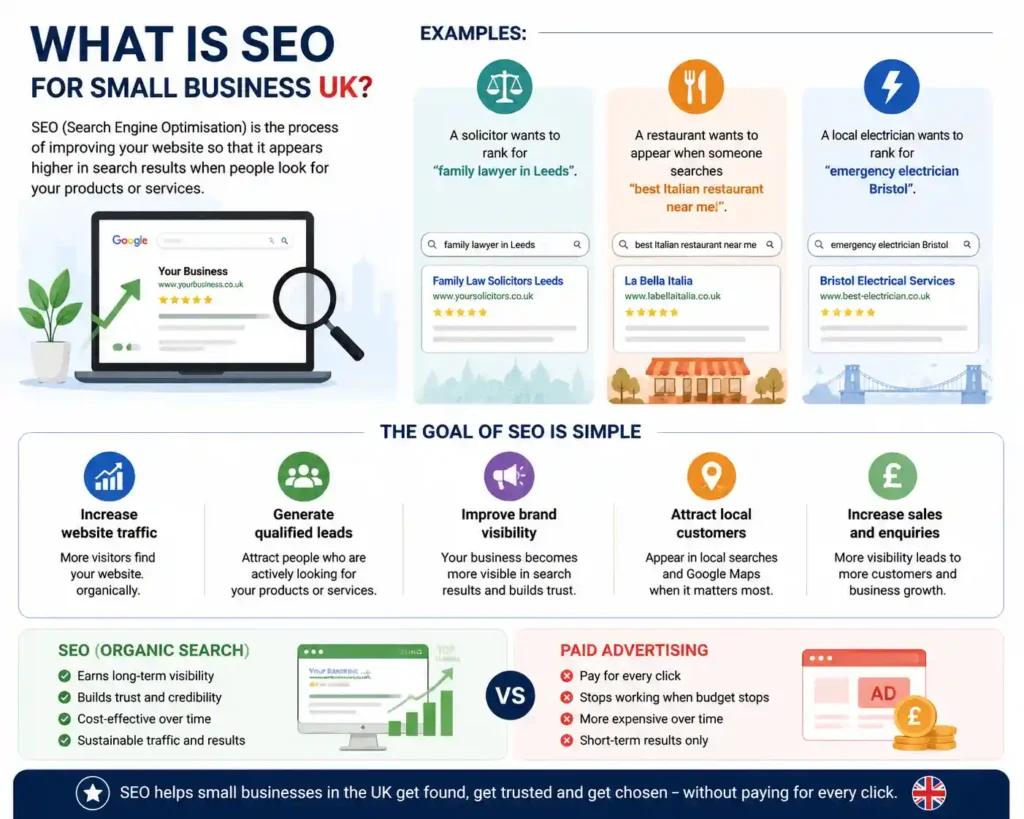
SEO, or Search Engine Optimisation, is the process of improving your website so that it appears higher in search results when people look for your products or services.
For example:
- A solicitor wants to rank for “family lawyer in Leeds”.
- A restaurant wants to appear when someone searches “best Italian restaurant near me”.
- A local electrician wants to rank for “emergency electrician Bristol”.
The goal of SEO is simple:
- Increase website traffic
- Generate qualified leads
- Improve brand visibility
- Attract local customers
- Increase sales and enquiries
Unlike paid advertising, SEO focuses on earning long-term visibility rather than paying for every click.
Why SEO Matters More Than Ever for UK Small Businesses
Consumer behaviour has changed.
Most buying journeys now start online, even when the purchase eventually happens in a physical store.
People research:
- Products
- Prices
- Reviews
- Opening hours
- Services
- Company reputation
Before making a decision.
If your business does not appear during these searches, competitors are likely to win the customer instead.
SEO has also become more important because digital advertising costs continue to rise. Many small businesses are finding that relying solely on Google Ads or social media advertising is becoming increasingly expensive.
Organic search provides an opportunity to generate traffic and leads without paying for every visitor.
How Search Has Changed in 2026
SEO is no longer just about ranking for keywords.
Google increasingly uses artificial intelligence to understand:
- User intent
- Business reputation
- Website quality
- Content expertise
- Brand authority
AI Overviews and answer engines are changing how users interact with search results. Instead of showing ten blue links, search engines increasingly provide direct answers.
This means businesses need to become trusted sources of information rather than simply targeting keywords.
The companies that demonstrate expertise and provide genuinely useful content are likely to perform best.
The Main Benefits of SEO for Small Businesses
More Website Traffic
SEO helps potential customers find your business when they actively search for your products or services. This traffic is often highly targeted because users already have a need or problem they want to solve.
Better Quality Leads
A person searching for “accountant for small business in Liverpool” has much stronger purchase intent than someone casually scrolling through social media.
SEO helps attract people who are already looking for what you offer.
Lower Marketing Costs
While SEO requires investment, it often delivers a lower cost per lead compared with paid advertising over the long term.
Strong organic rankings can continue generating enquiries for years.
Increased Credibility
People naturally trust businesses that appear prominently in search results.
High rankings can strengthen brand authority and improve customer confidence.
Long-Term Growth
Unlike advertising campaigns that stop producing results once the budget ends, SEO continues to provide value over time.
The Different Types of SEO
Technical SEO
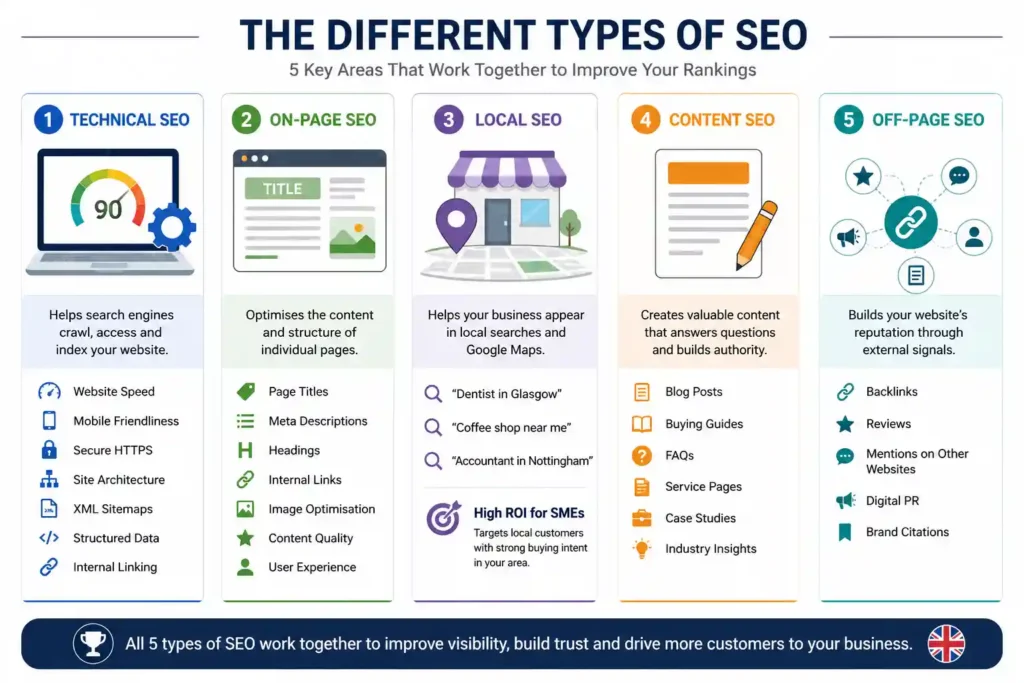
Technical SEO focuses on ensuring that search engines can access, understand and index your website.
Important areas include:
- Website speed
- Mobile friendliness
- Secure HTTPS
- Site architecture
- XML sitemaps
- Structured data
- Internal linking
A technically poor website may struggle to rank regardless of content quality. Our technical SEO audit checklist covers the main crawlability, indexing and site-health checks in more detail.
On-Page SEO
On-page SEO involves optimising the content and structure of individual pages.
This includes:
- Page titles
- Meta descriptions
- Headings
- Internal links
- Image optimisation
- Content quality
- User experience
Every page should answer a specific search intent.
Local SEO
Local SEO focuses on helping businesses appear in searches within a specific geographic area.
Examples include:
- Dentist in Glasgow
- Coffee shop near me
- Accountant in Nottingham
For many SMEs, local SEO provides the highest return on investment because it targets customers with immediate purchasing intent. If local visibility is the priority, our local SEO guide for small businesses explains the foundations.
Content SEO
Content SEO involves creating useful and informative material that answers customer questions.
Examples include:
- Blog posts
- Buying guides
- FAQs
- Service pages
- Case studies
- Industry insights
Good content helps build trust and authority.
Off-Page SEO
Off-page SEO focuses on signals that exist outside your website.
These include:
- Backlinks
- Reviews
- Mentions on other websites
- Digital PR
- Brand citations
These factors help search engines understand whether your business is trustworthy.
Why Local SEO Is Essential for UK Businesses
Local search continues to grow.
People increasingly search using phrases such as:
- “near me”
- “open now”
- “best in my area”
Google often displays map listings before traditional search results.
For local businesses, appearing in these results can significantly increase enquiries and foot traffic.
Businesses that ignore local SEO are often leaving valuable customers for competitors.
Optimise Your Google Business Profile
Your Google Business Profile is one of the most important local SEO assets you have.
A complete profile should include:
- Business name
- Address
- Telephone number
- Website
- Services
- Business description
- Opening hours
- Images
Regular updates and accurate information help improve local visibility.
Why Reviews Matter
Reviews influence both rankings and customer decisions.
Consumers trust online reviews in much the same way they trust personal recommendations.
Encourage satisfied customers to leave genuine feedback and respond professionally to all reviews, including negative ones.
A strong review profile can improve both search visibility and conversion rates.
Why Content Is Still King
Despite the rise of AI search, content remains at the heart of SEO.
Search engines need information to understand:
- What you do
- Who you serve
- Why you are trustworthy
Useful content demonstrates expertise and helps answer customer questions.
Small businesses should consider publishing:
- Service pages
- Location pages
- FAQs
- Guides
- Case studies
- Industry updates
Quality matters far more than quantity.
What Is an SEO Audit?
An SEO audit is a review of your website to identify issues that may be preventing better search performance.
A typical audit examines:
- Technical problems
- Website speed
- Indexing issues
- Broken links
- Content gaps
- Keyword opportunities
- Local SEO performance
Regular audits help businesses identify weaknesses and opportunities for growth.
How Much Does SEO Cost in the UK?
SEO costs vary significantly depending on competition and business goals.
Typical monthly pricing:
| Provider | Average Monthly Cost |
|---|---|
| Freelancer | £300–£800 |
| Small Agency | £500–£2,000 |
| Specialist Agency | £2,000+ |
Businesses should focus on return on investment rather than simply choosing the cheapest option.
Cheap SEO services often rely on outdated tactics that can damage long-term performance.
Can Small Businesses Do SEO Themselves?
Yes.
Many small businesses successfully manage basic SEO in-house.
Tasks that can often be handled internally include:
- Updating website content
Creating
blog posts
- Managing Google Business Profile
- Requesting reviews
- Improving service pages
However, technical SEO and advanced strategies often require specialist expertise.
The Biggest SEO Mistakes Small Businesses Make
Ignoring Local SEO
Many businesses underestimate the importance of map rankings and local visibility.
Buying Cheap Backlinks
Low-quality links can harm your website’s reputation.
Publishing Thin Content
Short, unhelpful pages rarely perform well.
Neglecting Website Speed
Slow websites frustrate users and hurt rankings.
Focusing Only on Keywords
Modern SEO is increasingly driven by expertise, trust and user experience.
How AI Is Changing SEO
Artificial intelligence is reshaping search.
Google increasingly provides direct answers to users without requiring them to visit websites.
This means businesses need to:
- Answer questions clearly
- Demonstrate expertise
- Build authority
- Use structured data
- Create genuinely useful content
SEO is becoming less about gaming algorithms and more about becoming the best source of information in your industry.
SEO Checklist for Small Businesses in the UK
✓ Optimise your Google Business Profile
✓ Improve website speed
✓ Create service pages
✓ Add location pages
✓ Collect customer reviews
✓ Publish helpful content
✓ Build quality backlinks
✓ Fix technical issues
✓ Monitor rankings and traffic
✓ Measure enquiries and leads
What Happens Next?
SEO for small business UK is entering a new era.
Artificial intelligence, local search and changing consumer behaviour are transforming how customers discover businesses online.
The companies that succeed will not necessarily be those with the largest marketing budgets.
They will be the businesses that build trust, provide useful information and become recognised authorities in their markets.
For UK small businesses, SEO remains one of the most effective long-term growth strategies available. If you want this work handled for you, see our SEO services for UK businesses.
The opportunity is not simply to rank higher in Google.
It is to become the business customers trust when they are ready to buy.
FAQ
Is SEO worth it for small businesses in the UK?
Yes. SEO can generate highly targeted traffic and leads while reducing reliance on paid advertising.
How long does SEO take?
Most businesses begin seeing improvements within three to six months, although competitive industries may take longer.
Do I need an SEO agency?
Not always. Many businesses can manage basic SEO themselves, but technical work and advanced strategies often benefit from professional support.
What is the most important part of SEO?
For most SMEs, local SEO, useful content and a well-optimised website provide the biggest impact.
Does AI mean SEO is dead?
No. AI is changing SEO, but businesses still need strong websites, authoritative content and trustworthy brands to remain visible online.