
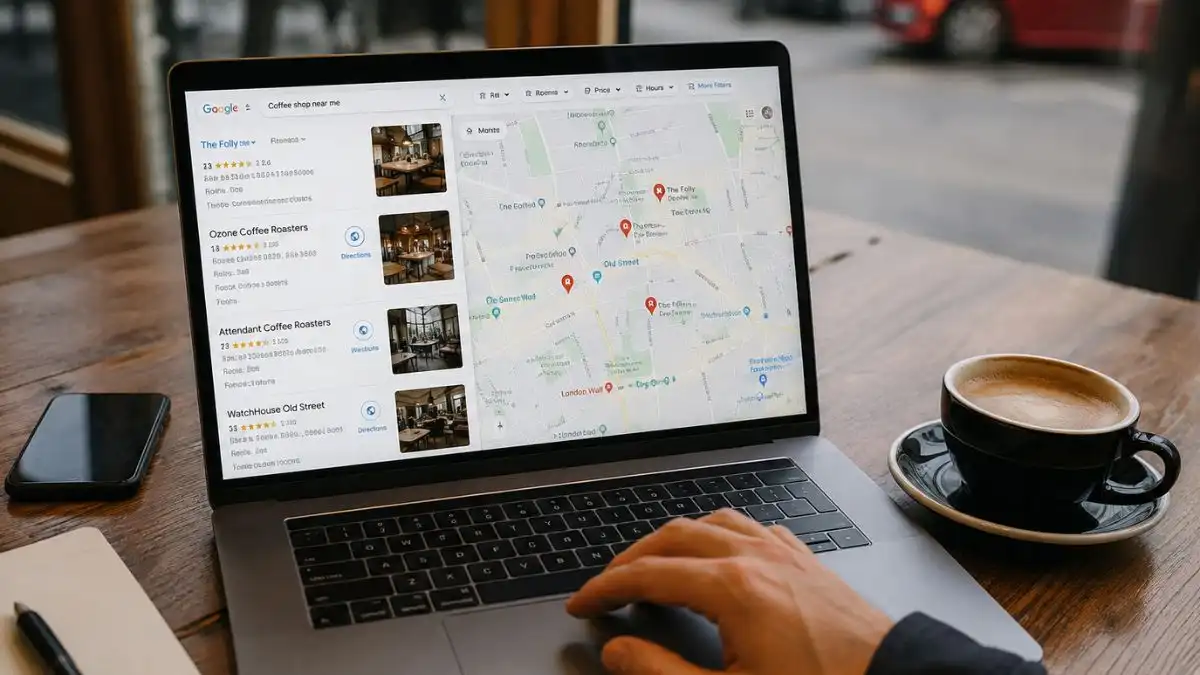

When people need a plumber, dentist, café, electrician or accountant, they rarely scroll through pages of search results. Most choose one of the businesses that appears in Google Maps.
That makes Google Maps one of the most valuable places for local businesses to be seen. A high ranking can lead to more phone calls, website visits, direction requests and customers walking through the door.
Many business owners assume rankings are based on reviews alone. Others think paying for Google Ads will move them to the top of the map. Neither is true.
Google uses hundreds of signals to decide which businesses deserve the best positions. Some are under your control. Others depend on where the searcher is, how complete your business information is and how trusted your business appears online.
This guide explains the Google Maps ranking factors that matter most, how Google chooses local businesses, and what you can do to improve your visibility without relying on shortcuts that could damage your rankings.
What Are Google Maps Ranking Factors?
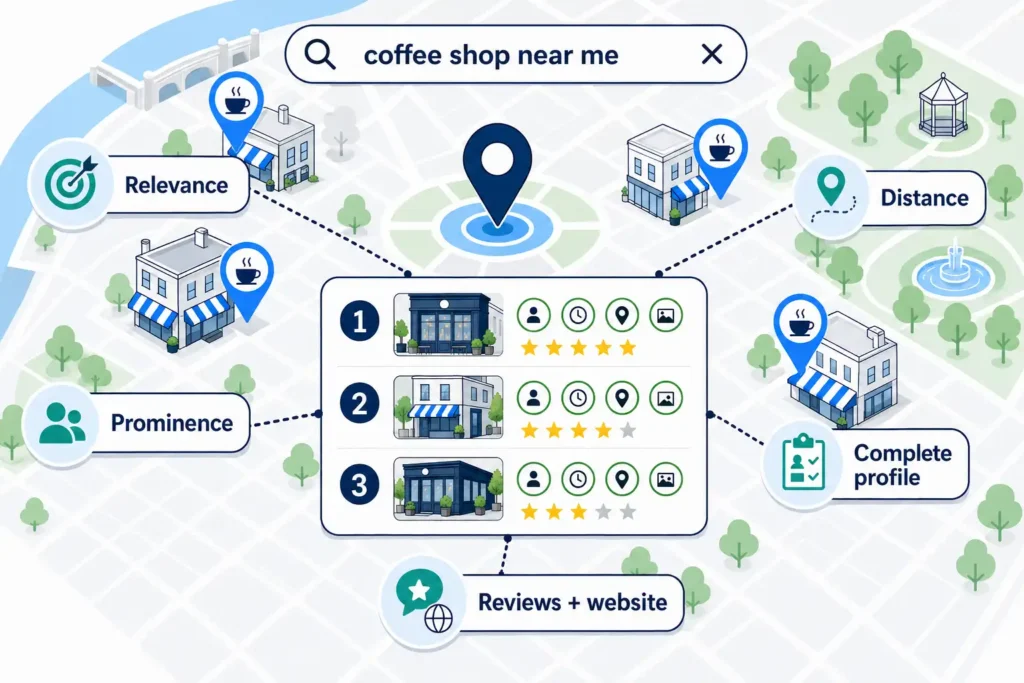
Google Maps ranking factors are the signals Google uses to decide which businesses appear in local search results and in what order.
For example, if someone searches for “coffee shop near me”, Google compares nearby businesses before deciding which three appear in the Local Pack and which others appear further down in Google Maps.
Instead of relying on a single factor, Google evaluates a wide range of information, including:
- How relevant the business is to the search
- How close it is to the searcher
- How well-known and trusted the business appears online
- Whether the Google Business Profile is complete
- Reviews, business information and website quality
The goal is simple: show users the businesses that are most likely to meet their needs.
How Does Google Decide Which Businesses Rank First?
Google has publicly explained that local rankings are mainly based on three core principles:
- Relevance
- Distance
- Prominence
Everything else helps Google understand these three signals better.
Let’s look at each one.
Relevance
Relevance measures how closely a business matches what someone is searching for.
Imagine two restaurants.
One has completed its Google Business Profile with categories, menu, services and photos.
The other has only a business name and phone number.
Even if both are nearby, Google has far more information to understand the first restaurant, making it easier to match with relevant searches.
That’s why choosing the right business categories, writing a clear business description and listing accurate services all matter.
Distance
Distance is exactly what it sounds like.
Google considers how far a business is from the person searching.
If someone searches “pharmacy near me”, Google usually favours nearby pharmacies over ones several kilometres away.
However, distance isn’t everything.
A well-established business slightly farther away may still rank above a closer competitor if it appears more relevant and trustworthy.
Prominence
Prominence reflects how well-known and credible a business appears.
Google looks at many signals, including:
- Online reviews
- Business reputation
- Website authority
- Mentions across trusted websites
- Local news coverage
- Business directories
- Links pointing to the website
Well-established businesses often have an advantage because they have built trust over many years.
That doesn’t mean new businesses cannot rank well. It simply means they need to build credibility over time.
Why Your Google Business Profile Matters
Your Google Business Profile is the foundation of your Google Maps presence. Without one, appearing in local search results becomes much more difficult. A complete profile helps Google understand exactly what your business does, where it operates and who it serves. It also gives customers the information they need before deciding to contact you.
A strong profile typically includes:
- Correct business name
- Primary and secondary categories
- Business description
- Opening hours
- Phone number
- Website
- Address or service area
- Products or services
- Photos
- Questions and answers
- Regular updates
The more accurate and complete your profile is, the easier it is for Google to understand your business.
Why Google Doesn’t Rank Every Business the Same
Many business owners search for their own company and wonder why they don’t appear first.
The reason is that Google personalises local search.
Two people searching the same phrase at the same time may see different results because Google considers factors such as:
- Their current location
- Previous searches
- Search intent
- Device
- Time of day
- Business availability
For example, someone standing in the city centre may see completely different restaurant results from someone searching five miles away.
This is why checking rankings from your own office doesn’t always show what customers see.
The Goal Isn’t Just Rankings
Ranking first on Google Maps is useful, but visibility alone doesn’t generate customers.
People also compare businesses before making a decision.
They often look at:
- Reviews
- Star ratings
- Photos
- Opening hours
- Recent updates
- Website quality
- Response to customer reviews
A business in second place with excellent reviews and professional photos may receive more enquiries than the business ranked first.
Google Maps success isn’t just about being seen. It’s about giving customers confidence to choose you.
The Most Important Google Maps Ranking Factors
Google has never published a complete list of local ranking signals. However, years of research, official guidance and real-world testing show that some factors consistently influence local visibility more than others.
Here are the ones every local business should understand.
1. A Complete Google Business Profile
Your Google Business Profile is often the first thing customers see. An incomplete profile makes it harder for Google to understand your business and easier for customers to choose a competitor.
Complete every section you can, including:
- Business name
- Address or service area
- Phone number
- Website
- Business hours
- Categories
- Services
- Products
- Business description
- Photos
- Attributes such as wheelchair access, outdoor seating or free Wi-Fi where relevant
A fully completed profile sends stronger signals than one with missing information.
2. Choosing the Right Business Category
Your primary category tells Google what your business is.
If you’re a bakery, selecting Bakery as your primary category is much better than choosing something broad like Food Store.
Secondary categories help Google understand additional services.
For example:
- A supermarket might also select Grocery Delivery Service.
- A dentist could add Cosmetic Dentist and Emergency Dental Service.
- A restaurant may include Takeaway Restaurant or Pizza Delivery.
Only choose categories that genuinely describe your business.
3. Accurate Business Information
Your business information should be correct everywhere online.
That includes your:
- Business name
- Address
- Phone number
- Website
This is often called NAP consistency.
If one website lists your business at an old address while another shows a different phone number, Google receives mixed signals.
Even small differences can create confusion over time.
Whenever your details change, update them across your website, directories and social profiles.
4. High-Quality Reviews
Reviews are one of the strongest trust signals for both customers and Google.
A business with hundreds of genuine, recent reviews often appears more trustworthy than one with only a handful.
Quality matters more than quantity.
Google looks at factors such as:
- Overall rating
- Number of reviews
- Review freshness
- Review content
- Review diversity
Natural reviews collected over time are far more valuable than a sudden burst of suspicious activity.
5. Responding to Reviews
Replying to reviews shows that you value customer feedback.
Whether a review is positive or negative, a thoughtful response demonstrates professionalism.
For positive reviews:
- Thank the customer.
- Keep your reply personal.
- Mention the service where appropriate.
For negative reviews:
- Stay calm.
- Address the issue professionally.
- Offer to resolve the problem.
Potential customers often read your responses before deciding whether to contact you.
6. Regularly Adding Photos
Photos help customers understand what to expect before they visit.
Businesses with fresh, authentic images often attract more attention than those using only a logo or stock photography.
Good photos include:
- Exterior views
- Interior spaces
- Staff
- Products
- Services
- Work completed
- Team members
- Before-and-after examples where appropriate
Update your gallery regularly rather than uploading dozens of images once and forgetting about it.
7. A Fast, Helpful Website
Google Maps and your website work together.
A well-designed website helps Google verify what your business does and where it operates.
Your website should clearly explain:
- Your services
- Your location
- Areas you serve
- Contact information
- Business hours
- Customer reviews
- Frequently asked questions
Fast loading speeds, mobile-friendly pages and clear navigation also improve the user experience.
8. Local SEO on Your Website
Your website should support your Google Business Profile, not contradict it.
Useful local SEO includes:
- Location pages
- Local service pages
- Customer case studies
- Area-specific content
- Embedded Google Map
- Consistent contact details
If you serve several towns or cities, create useful pages for each area instead of trying to rank one page for everything.
9. Local Backlinks
Backlinks remain an important trust signal.
When respected local organisations link to your website, Google sees additional evidence that your business is genuine.
Examples include:
- Local newspapers
- Chambers of commerce
- Business associations
- Community organisations
- Charity partnerships
- Local events
- Industry organisations
A few high-quality local links are often more valuable than hundreds of low-quality ones.
10. Business Citations
A citation is any online mention of your business information.
Examples include:
- Business directories
- Industry directories
- Local business listings
- Trade associations
- Professional organisations
The goal is consistency, not quantity.
Avoid submitting your business to hundreds of low-quality directories simply to build links.
11. Local Content
Publishing useful local content helps Google understand your connection to an area.
Examples include:
- Local project case studies
- Community involvement
- Area guides
- Event sponsorships
- Local news
- Customer success stories
This type of content also gives other local websites a reason to link to your business.
12. User Engagement
Google can measure how people interact with your business listing.
While Google doesn’t explain exactly how these signals affect rankings, user engagement helps indicate whether people find your business useful.
Examples include:
- Clicking for directions
- Calling directly from the listing
- Visiting your website
- Viewing photos
- Reading reviews
Businesses that consistently attract customer interest often build stronger local visibility over time.
13. Business Hours
Keep your opening hours accurate.
Nothing frustrates customers more than arriving at a business that’s unexpectedly closed.
Update your profile for:
- Public holidays
- Seasonal hours
- Temporary closures
- Special events
Google wants to show reliable information, and accurate hours help build trust.
14. Google Business Profile Updates
Many businesses claim their profile and never touch it again.
Keeping it active helps ensure customers always see current information.
You can regularly update:
- Photos
- Services
- Products
- Business description
- Opening hours
- Contact details
An up-to-date profile provides a better experience for both Google and potential customers.
15. Business Reputation Beyond Google
Google doesn’t only look at your Business Profile. It also considers your reputation across the wider web. Positive mentions from trusted websites, local media, industry publications and respected organisations all help reinforce your business’s credibility. Building a strong reputation takes time, but it benefits both your Google Maps visibility and your overall online presence.
One Thing to Remember
No single factor guarantees the number one position on Google Maps.
A business with excellent reviews but poor website information may struggle to rank. Another with a great website but an incomplete Business Profile could face the same problem.
The strongest local businesses usually perform well across multiple areas. They keep their information accurate, earn genuine customer reviews, maintain a helpful website and consistently build trust over time.
That combination gives Google more confidence that the business deserves to appear when local customers are searching.
Common Google Maps Ranking Mistakes That Hold Businesses Back
Many businesses don’t struggle because Google is ignoring them. They struggle because they overlook small details that make a big difference.
Avoiding these mistakes won’t guarantee a top ranking, but it can remove barriers that stop your business from performing well in local search.
Leaving Your Google Business Profile Incomplete
Some businesses claim their profile, add a phone number and never return.
Missing categories, business hours, services or photos make it harder for Google to understand what you offer.
An incomplete profile can also make customers choose a competitor that provides more information.
Set aside time every few months to review your profile and make sure everything is still accurate.
Choosing the Wrong Business Category
Your primary category should describe your main business activity.
For example, a bakery that selects Coffee Shop as its primary category may miss searches from people looking specifically for bakeries.
Secondary categories are useful, but they should only reflect services you genuinely provide.
Trying to appear in unrelated searches usually has the opposite effect.
Ignoring Customer Reviews
Reviews influence both trust and customer decisions.
Some businesses receive reviews but never respond. Others stop asking for feedback altogether.
Encourage satisfied customers to leave honest reviews after completing a job or making a purchase.
Don’t offer rewards or incentives in exchange for reviews, as this goes against Google’s policies.
Using Fake Reviews
Buying reviews might seem like a quick way to improve your rating, but it carries significant risks.
Google continues to improve its ability to detect suspicious review activity.
Fake reviews can be removed, your profile may lose credibility and customers are becoming better at spotting reviews that don’t sound genuine.
It’s always better to earn real feedback from real customers.
Letting Business Information Become Outdated
Businesses change over time.
You might move to a new location, change your phone number or update your opening hours.
If your Google Business Profile, website and business directories all show different information, customers become confused and Google receives mixed signals.
Whenever your business details change, update them everywhere.
Neglecting Your Website
Some business owners assume their Google Business Profile is enough.
It isn’t.
Your website helps Google confirm who you are, what you do and where you work.
An outdated website with broken pages, slow loading times or missing contact information can weaken your overall local presence.
Think of your website and Google Business Profile as working together rather than competing.
Using Poor-Quality Photos
Photos often influence customer decisions before they even visit your website.
Dark, blurry or outdated images don’t create a good first impression.
You don’t need expensive equipment.
Modern smartphones can capture high-quality images of:
- Your premises
- Products
- Team members
- Vehicles
- Completed projects
- Interior spaces
Fresh, authentic photos usually perform better than generic stock images.
Forgetting About Mobile Users
Most local searches happen on mobile devices.
If your website is difficult to use on a phone, visitors may leave before contacting you.
Check that customers can easily:
- Read your content
- Call your business
- Get directions
- Fill in contact forms
- View your services
A simple mobile experience often leads to more enquiries.
Trying to Manipulate Rankings
Some businesses try to force higher rankings by:
- Stuffing keywords into their business name
- Creating fake locations
- Using virtual offices as physical addresses
- Adding services they don’t actually provide
These tactics may produce short-term gains, but they also increase the risk of profile suspension or reduced visibility.
Building genuine trust takes longer, but it delivers more stable results.
Expecting Overnight Success
Local SEO is not an instant process.
A new business usually needs time to build:
- Reviews
- Website authority
- Local mentions
- Customer engagement
- Brand recognition
Businesses that consistently improve their online presence often see better results over the months rather than the weeks.
Patience and consistency are usually more effective than constantly chasing shortcuts.
How to Improve Your Google Maps Rankings
Improving your Google Maps visibility doesn’t require complicated tricks. It requires consistency.
Start with the basics and build from there.
Complete your Google Business Profile
Fill in every section that applies to your business.
Google can only understand the information you provide.
Keep your information accurate
Make sure your:
- Business name
- Address
- Phone number
- Website
- Opening hours
match across your website, Google Business Profile and other trusted directories.
Ask for Genuine Reviews
Make requesting reviews part of your normal customer journey.
For example:
- After completing a service
- After a successful delivery
- Following a positive customer interaction
A steady flow of genuine reviews looks more natural than receiving dozens at once.
Respond to Every Review
Thank customers for positive feedback.
Address negative reviews professionally and try to resolve issues where possible.
Future customers often read your responses as carefully as the reviews themselves.
Improve Your Website
Your website should clearly explain:
- Who you are
- What you do
- Where you work
- How customers can contact you
Simple navigation, fast loading speeds and useful information all contribute to a better user experience.
Publish Helpful Local Content
Instead of writing articles just to include keywords, create content that answers real questions from local customers.
Examples include:
- Service guides
- Local case studies
- Community projects
- Seasonal advice
- Frequently asked questions
Helpful content builds trust with both customers and search engines.
Keep Your Profile Active
Review your Google Business Profile regularly. Add new photos, update services and check that all business information remains correct. An active profile is more useful to customers than one that hasn’t changed in years.
Build Your Reputation
Strong local businesses are known beyond Google.
Take part in community events, support local organisations, earn mentions in local news and build relationships within your industry.
These activities strengthen your reputation both online and offline.
Focus on the Customer First
Many people spend all their time trying to understand Google’s algorithm.
A better approach is to think about the customer.
Ask yourself:
- Does my profile answer common questions?
- Are my contact details easy to find?
- Do my photos show what customers can expect?
- Would I choose my own business over the competition?
If the answer is yes, you’re already moving in the right direction.
Google’s goal is to recommend businesses that provide a good experience. The businesses that consistently meet customer expectations are often the ones that perform best over time.